How >>Much Does ERP Cost in India (2026)? Real Pricing, ROI & Hidden Fees
Complete Cost Breakdown, Vendor Comparison & Decision Guide for SMEs
Know your exact investment before making a decision.
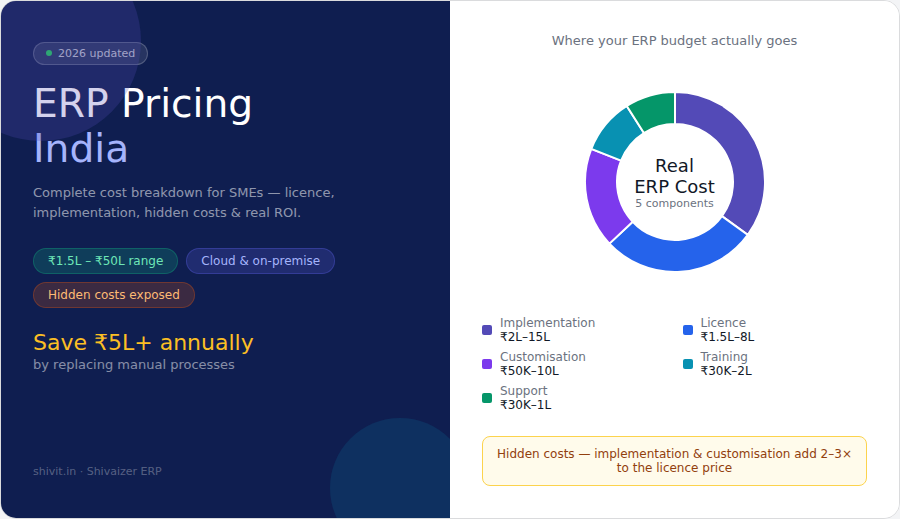
| ERP software pricing in India typically ranges from ₹1.5 lakh to ₹50 lakh depending on business size, users, and features. |
The Real Problem: Why You’re Likely Spending Too Much Right Now
You’re sitting in a board meeting. Your finance director slides across a quote for ERP software: ₹3 lakhs per year. It looks reasonable — until you start asking questions.
“What about implementation?” asks your operations manager. Nobody has a clear answer. Two weeks later, another email arrives: implementation will cost ₹10 lakhs. Then training: ₹1.5 lakhs. Then customisation: ₹5 lakhs. Infrastructure, data migration, integrations — each one adding more cost.
By go-live, you’ve spent ₹25 lakhs. Your CFO asks why the real numbers weren’t transparent from day one.
| Here’s the hard truth: Most businesses don’t realise they’re already paying ₹12L–₹32L annually in hidden costs from manual processes. Inefficient inventory, delayed billing, manual reconciliation, duplicate orders — all of it costs more than ERP would actually cost. |
| Most businesses don’t realise they are already paying more for inefficiencies than ERP would actually cost. |
This guide cuts through the confusion. You’ll understand exactly what ERP costs in India, how pricing breaks down across vendors, which solution fits your business, and — most importantly — whether the investment actually pays off for you.
How Much Does ERP Software Actually Cost in India?
| ERP software pricing in India typically ranges from ₹1.5 lakh to ₹50 lakh depending on business size, users, and features. But that’s just the licence. Real ERP investment is 3–5× higher. |
For a typical SME with 20 employees evaluating cloud-based ERP, expect a first-year total investment between ₹8 lakhs to ₹15 lakhs (licence + implementation + training).
The good news? That investment pays itself back within 12–18 months through operational savings — but only if you choose the right solution and implement it properly.
Breaking Down ERP Costs: Where Your Money Actually Goes
Understanding ERP pricing means looking beyond the headline number. Each cost component matters — and vendors don’t always volunteer the full picture upfront.
1. Software Licence Cost (₹1.5L – ₹8L / year)
This is what vendors quote first — but it’s only 20–30% of your real cost.
- Per-user model (Zoho, SAP): ₹8,000–₹15,000 per user per year. A 20-user business pays ₹1.6L–₹3L for licences alone. Add manufacturing modules: +₹30K–₹50K.
- Flat licensing model (Odoo, flexible ERPs): ₹2L–₹4L annually regardless of user count — economical as you scale.
- Cloud vs on-premise: Cloud licences run ₹1.5L–₹3L for SMEs. On-premise: ₹3L–₹8L (perpetual ownership).
2. Implementation Cost (₹2L – ₹15L, one-time)
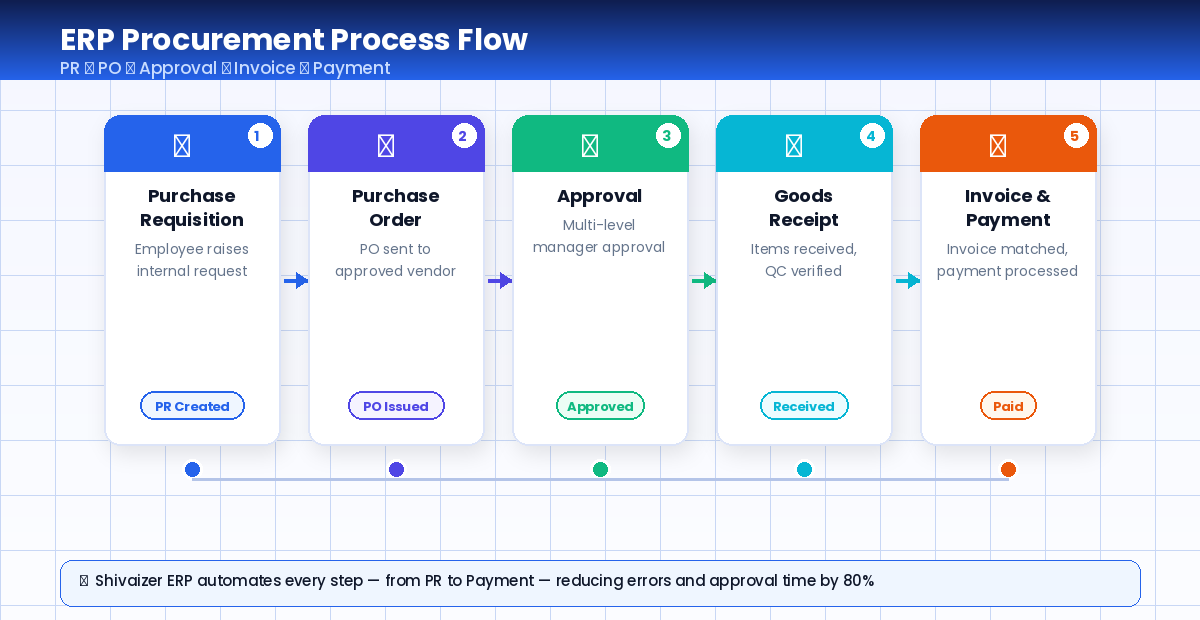
Implementation is where SME budgets get shocked. This covers configuration, business process mapping, data migration, and go-live support.
- Small business, straightforward operations: 4–6 weeks → ₹2L–₹4L
- Manufacturing business with complex workflows: 12–16 weeks → ₹8L–₹15L
- Vendors typically charge ₹15,000–₹25,000 per day for this work.
3. Customisation (₹50K – ₹10L)
Not all businesses fit standard workflows. GST tracking, approval chains, legacy integrations — each one adds cost.
- Small customisation (5–10 custom fields, 2–3 workflows): ₹50K–₹1L
- Moderate customisation (2–3 custom modules, integrations): ₹2L–₹5L
- Heavy customisation (5+ features, complex APIs): ₹5L–₹10L+
Key insight: Cheaper ERPs often cost more in customisation because they’re less flexible. A well-designed ERP adapts to your processes — not the other way around.
4. Training & Change Management (₹30K – ₹2L)
- Basic training (2–3 days, standard materials): ₹30K–₹50K
- Comprehensive training (5–7 days, role-specific): ₹80K–₹1.5L
- Extended support (dedicated success manager, 3–6 months): ₹1L–₹2L
Reality check: Many SMEs skip adequate training and regret it. Under-trained teams use only 40% of ERP features, losing most ROI benefits.
5. Annual Maintenance & Support (₹30K – ₹1L / year from Year 2)
Most vendors charge 15–20% of your licence cost annually. For a ₹3L licence, expect ₹45K–₹60K per year for bug fixes, updates, and technical support.
6. Infrastructure / Cloud Hosting (₹20K – ₹1L / year)
- Standard cloud hosting (up to 50 users): ₹20K–₹40K/year
- High-volume with redundancy (100+ users): ₹60K–₹1L/year
- On-premise: Dedicated server (₹1.5L–₹3L upfront) + ₹30K–₹50K annual maintenance
| Want an exact ERP cost for your business? Get a free pricing estimate in 2 minutes. |
| No sales pressure. Just clarity on your investment. |
Real-World ERP Cost Examples by Business Size
Numbers are abstract. Here’s what actual Indian SMEs spend across different business profiles.
Example 1: Small Trading Company (12 Users, 2 Locations)
Business profile: Retail + online sales, inventory across two warehouses, billing, and accounting.
- Cloud ERP licence: ₹1.8L
- Implementation (4 weeks): ₹3L
- Training & documentation: ₹40K
- Customisation (inventory, multi-location): ₹80K
Total Year 1: ₹5.2L | Year 2+: ₹2.1L annually (licence + support)
Example 2: Manufacturing SME (25 Users, 1 Location)
Business profile: Production planning, bill of materials, quality tracking, and financial accounting.
- Cloud ERP with manufacturing modules: ₹2.5L
- Implementation (6–8 weeks): ₹6L
- Customisation (workflows, quality control): ₹1.2L
- Training (multiple shifts): ₹80K
- Quality testing infrastructure: ₹40K
Total Year 1: ₹10.2L | 3-Year Total: ₹15.7L | Annual savings from Year 2: ₹8L–₹12L | Payback: 15–18 months
Example 3: Growing Distribution Company (40+ Users, 4 Locations)
Business profile: Multiple warehouses, sales teams, complex inter-location inventory.
- Cloud ERP licence with advanced features: ₹4L
- Implementation (8–10 weeks, multi-location): ₹8L
- Customisation (warehouse sync, inter-location transfers): ₹1.5L
- Training (multiple batches): ₹1.2L
- Mobile app for warehouse teams: ₹50K
Total Year 1: ₹14.7L | 3-Year Total: ₹23.7L | Annual savings: ₹15L–₹20L | Payback: 12–14 months
Cloud ERP vs On-Premise ERP: Real Cost Comparison
This is the question every SME asks. The numbers strongly favour cloud for most businesses.
Cloud ERP Economics
- Year 1 total: ₹5.5L–₹10.8L (licence + implementation + training)
- Year 2+ annually: ₹2.3L–₹4.6L (licence + support)
- 5-Year Total: ₹13L–₹24L
Cloud advantages:
- No server hardware to buy or maintain
- Automatic updates — no painful version upgrades every 3 years
- Accessible from anywhere; scales easily from 20 to 100+ users
- Better security (vendor-managed)
On-Premise ERP Economics
- Year 1 total: ₹10L–₹21L (licence + server + installation)
- Year 2+ annually: ₹1.3L–₹2.1L (support, server maintenance, backups)
- 5-Year Total (including Year 3 upgrade): ₹17L–₹32L
| Verdict for SMEs: Cloud ERP saves 30–40% over 5 years. A 20-user trading company pays ₹13L–₹16L over 5 years with cloud vs ₹20L–₹28L on-premise — a ₹7L–₹12L difference. Unless you have specific offline or regulatory requirements, cloud is the smart choice. |
Top ERP Solutions Compared: Which Fits Your Business?
Use this table to compare the leading ERP options available to Indian SMEs. Pay attention to SME Fit — not all solutions are built for your scale.
| ERP Solution | Annual Price | Implementation | Best For | SME Fit |
| Tally Prime | ₹30K – ₹1L | 2–4 weeks | Small traders / accounting only | Excellent (very small) |
| Zoho One | ₹2L – ₹4L | 4–8 weeks | Growing SMEs, integrated suite | Excellent |
| Odoo (Cloud) | ₹1.5L – ₹3.5L | 6–10 weeks | Flexible SMEs, custom needs | Excellent |
| SAP Business One | ₹5L – ₹12L | 8–16 weeks | Growing manufacturers | Moderate (complex) |
| Oracle NetSuite | ₹8L – ₹20L | 12–20 weeks | Global / enterprise operations | Limited (enterprise) |
| Microsoft Dynamics 365 | ₹3L – ₹8L | 8–12 weeks | Microsoft ecosystem users | Moderate |
| Shivaizer (Shivit Technologies) | Flexible | 2–4 weeks | SMEs wanting simplicity & scale | Excellent |
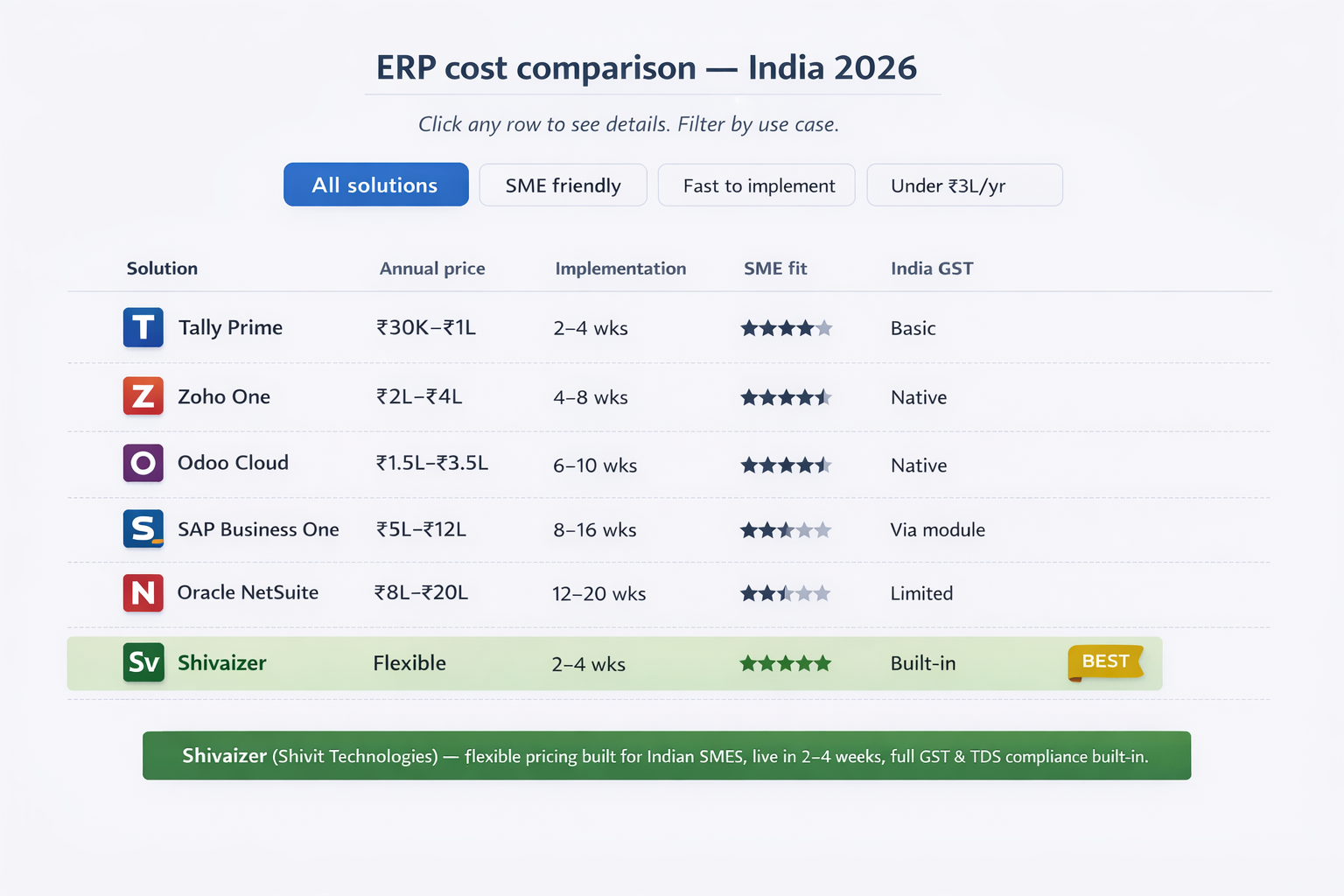
Key observations:
- Tally is not a true ERP — it’s accounting software. You’ll outgrow it, and migration later is expensive.
- Zoho & Odoo dominate the SME segment: fast to deploy, affordable, strong India compliance (GST, TDS, e-invoicing).
- SAP & Oracle are 3–5× more expensive and take 3× longer to implement — built for large enterprises, not SMEs.
→ Still confused between ERP options? See which solution fits your business — get a personalised recommendation. ←
Why SMEs Prefer Flexible ERP Solutions Today
The ERP landscape has shifted. SMEs are moving away from rigid, complex systems — and for good reason.
SAP & Oracle: Expensive, complex, and slow to implement. Designed for large enterprises. Most SMEs spend 12–20 weeks just getting live — time and money they can’t afford.
Tally: Great for small-scale accounting, but limited scalability. When you grow, migration is painful and costly. It was never meant to run a business — just record one.
Zoho: A solid platform, but generic. It doesn’t adapt well to specific industry workflows, especially for manufacturing or distribution businesses with unique processes.
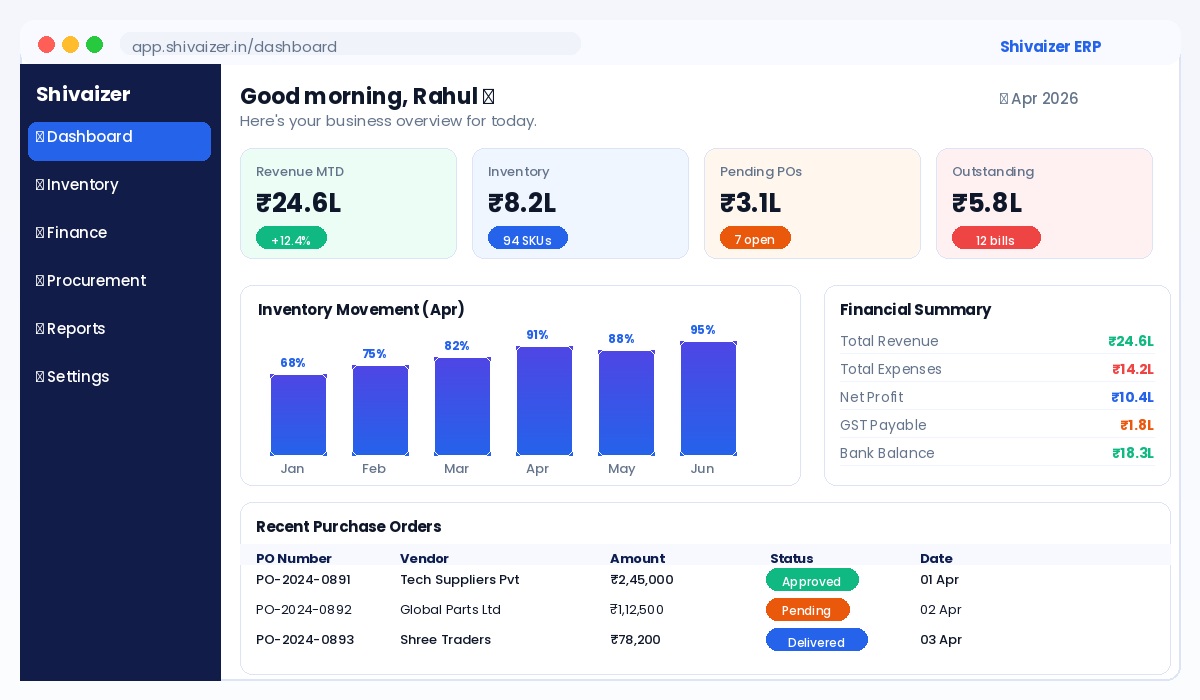
What’s changing: Many SMEs today prefer flexible ERP solutions like Shivaizer that adapt to their workflows instead of forcing business changes.
These solutions:
- Get implemented in weeks, not months
- Cost 50% less than traditional enterprise ERP
- Scale with you from 10 users to 100+ without massive overhauls
- Include Indian compliance built-in — GST, TDS, e-invoicing, statutory reporting
- Offer transparent, predictable pricing with no surprise overruns
What Happens If You Skip ERP? The Real Cost of Staying Manual
| Most businesses don’t realise they are already paying more for inefficiencies than ERP would actually cost. |
Inventory Management Without ERP: ₹5L–₹15L Annual Waste
Without real-time tracking, you overstock slow movers and run out of bestsellers. A typical small trading business loses 8–12% of inventory value annually. For ₹1Cr inventory: ₹8L–₹12L yearly waste. Add stockout losses (2–3% of revenue): another ₹1L–₹1.5L.
Billing & Collections Delays: ₹3L–₹8L Annual Drag
Invoices take days to create. No automated reminders. Collections take months instead of weeks. For a ₹5Cr revenue business with 30-day terms, a 10-day payment delay costs ₹13L annually in interest. ERP reduces delays to 3–5 days: ₹4L–₹6L annual savings.
Manual Reconciliation: ₹2L–₹4L Annual Labour Cost
Finance teams spend 5–7 days monthly reconciling manually — 60–84 days annually of ₹3,000–₹5,000/day staff time. ERP reduces this to 1–2 days. Your team focuses on analysis instead of data entry.
Duplicate Orders & Procurement Waste: ₹2L–₹5L Annual Waste
Without purchase order controls and budget checks, procurement waste runs at 3–5% of annual purchases. For ₹1Cr procurement: ₹3L–₹5L wasted — mostly invisible.
| Total Cost of Staying Manual: ₹12.3L–₹32L annually. Your ₹8L–₹15L Year 1 ERP investment pays itself back in 6–15 months — not through new revenue, but by stopping this waste. |
ROI Breakdown: Why ERP Actually Pays for Itself
Let’s project realistic returns for a typical 25-person manufacturing SME.
Year 1: Implementation Year
Investment: ₹10L (licence + implementation + training)
- 5% inventory optimisation: ₹3L
- 20% faster billing & collections: ₹2L
- 30% reduction in manual data entry: ₹1.5L
- Procurement error reduction: ₹1.5L
Total Year 1 Savings: ₹8L | Year 1 ROI: 80% | Break-even: Month 15
Year 2: Full Operation
Investment: ₹2.5L (licence + support)
- Inventory carrying cost reduction: ₹4L
- Cash conversion cycle improvement: ₹3.5L
- Labour efficiency gains: ₹2L
- Faster decision-making value: ₹2L
Total Year 2 Savings: ₹11.5L | Year 2 ROI: 460%
3-Year Projection
| Year | Investment | Savings | ROI | Cumulative Benefit |
| Year 1 | ₹10L | ₹8L | 80% | –₹2L |
| Year 2 | ₹2.5L | ₹11.5L | 460% | +₹7L |
| Year 3 | ₹2.5L | ₹12L | 480% | +₹16.5L |
3-Year Summary: Total Investment ₹15L → Total Savings ₹31.5L → Net Benefit ₹16.5L → Overall ROI: 110%
Even conservative estimates show payback in 12–18 months, with cumulative benefits reaching ₹15L–₹20L by Year 3.
→ See how much your business can save with ERP — book a quick demo and get a custom ROI calculation. ←
Get Your ERP Cost Estimate in 30 Seconds
Use this framework to instantly ballpark your investment based on your business profile.
Step 1 — Base Licence by User Count
- 10–20 users: ₹1.5L–₹2.5L
- 21–40 users: ₹2.5L–₹4L
- 41–60 users: ₹4L–₹6L
- 60+ users: Custom pricing
Step 2 — Add Module Complexity
- Finance only: Base cost
- Finance + Inventory: + ₹30K
- Finance + Inventory + Manufacturing: + ₹80K
- Finance + Inventory + Manufacturing + CRM: + ₹1.5L
- Full suite: + ₹2L
Step 3 — Factor Implementation Effort
- Simple (single location, standard workflows): ₹2L–₹3L
- Moderate (multi-location, some customisation): ₹4L–₹6L
- Complex (heavy customisation, multiple integrations): ₹8L–₹12L
Quick Examples
- Small trading company (15 users, finance + inventory, simple): ₹1.5L + ₹30K + ₹2.5L = ₹4.2L Year 1
- Growing manufacturing (30 users, all modules, moderate): ₹3.5L + ₹1.5L + ₹5L = ₹10L Year 1
- Distribution company (50 users, inventory + CRM, complex): ₹5L + ₹1.5L + ₹8L = ₹14.5L Year 1
| Get Instant Estimate — Answer 3 quick questions and see your exact ERP investment. |
| Free. No obligation. Takes 2 minutes. |
What SMEs Look for in ERP Today
ERP selection criteria has evolved. SMEs now prioritise very differently from large enterprises — and rightly so.
✅ Easy Implementation — Go live in weeks, not months. Minimal business disruption.
✅ Scalable System — Grows with you from 10 to 100+ users without massive overhauls.
✅ Reliable Support — Local India-based support team who understands your compliance needs.
✅ Cost Visibility — Transparent pricing with no surprise implementation overruns.
✅ Flexible Configuration — Adapts to your workflows instead of forcing process changes.
✅ Indian Compliance Built-In — GST, TDS, e-invoicing, statutory reporting all native.
✅ Quick ROI — Generates measurable savings within 12–18 months.
Modern flexible ERP solutions check all these boxes. Legacy systems typically check only 2–3 of them.
How to Choose the Right ERP: A Practical Buyer Checklist
Before you commit to any vendor, work through these critical questions. The answers will tell you more than any sales demo.
Team Readiness & Technical Capability
- Does your team embrace new technology? If not, implementation becomes painful before it gets useful.
- Can you dedicate one key person 50–100% during implementation? For a 10-week project, you need one champion.
- Is there a clear executive sponsor driving adoption? Missing this causes 40% of ERP failures.
Business Process Clarity
- Do you have documented processes? If your business runs on ‘how we’ve always done it’, implementation becomes transformation — more expensive, longer timeline.
- Are processes standardised across locations? Multi-location businesses with different workflows need heavy customisation.
- How complex are your workflows? Simple trading → basic ERP. Manufacturing → enterprise features.
Financial Readiness
- Can you afford the full Year 1 investment — not just the software? Many SMEs budget for licence only, then get shocked.
- Have you planned a 10–15% contingency budget? Integration surprises and custom development overruns are common.
- Can you justify the cost based on current pain? If you have no inventory issues, no cash flow problems, and a quick month-end close, ERP ROI is marginal.
Vendor & Implementation Partner Evaluation
- Is the vendor financially stable? Will they be in business in 5 years?
- Do they have a strong India presence? Global vendors with limited India resources can’t support GST, TDS, e-invoicing adequately.
- Who will implement it? Implementation success depends 80% on the partner, not the software. Vet their track record.
- Call 3–5 reference customers. Ask: Did it launch on time? Was support adequate during go-live? Would you choose this vendor again?
→ Still deciding between ERP options? Get a personalised recommendation based on your industry and business size. ←
FAQ: Your Top ERP Pricing Questions Answered
Q1. What is the minimum ERP investment for a small business?
The absolute minimum for functional ERP is ₹4L–₹6L in Year 1. This assumes a simple business (trading or services), under 20 users, minimal customisation, and standard workflows. Anything less and you’re not getting a true ERP — you’re getting accounting software. The investment seems high, but you’ll recover it within 12–18 months through operational efficiencies.
Q2. Why do manufacturing ERPs cost more than trading ERPs?
Manufacturing requires complex features that trading doesn’t: bill of materials, production planning, work orders, quality control, machine integration, batch tracking, variance analysis. Each adds ₹50K–₹2L to base cost. Manufacturing workflows also vary more, requiring heavier customisation and longer implementation (12–16 weeks vs 5–8 weeks for trading).
Q3. Is cloud ERP cheaper than on-premise?
Yes, definitively. Cloud is 30–40% cheaper over 5 years for most SMEs. You avoid server costs (₹1.5L–₹3L), infrastructure (₹30K–₹50K/year), version upgrades (₹2L every 3 years), and dedicated IT staff (₹3L–₹6L annually). Unless you have specific offline or regulatory requirements, cloud is the economical choice.
Q4. Should I choose the cheapest ERP to minimise costs?
No. The cheapest ERP often costs the most in total. Inflexible base systems require heavy customisation (+₹2L–₹5L). Budget vendors cut implementation corners. Limited functionality creates manual workarounds. Complicated interfaces kill user adoption — and an unused ERP has zero ROI. Choose based on fit first, implementation quality second, price third.
Q5. What’s the typical payback period?
For well-executed implementations: 12–18 months. Manufacturing typically sees faster payback (12–15 months) due to inventory optimisation and production gains. Service businesses see slower payback (20–24 months). Poorly executed implementations may never break even if users don’t adopt the system properly.
Q6. Can I implement ERP with a limited budget of ₹5L?
Not really — unless your business is extremely simple (single location, under 10 users, no customisation). Cutting corners at ₹5L typically results in a poorly configured system that doesn’t match your workflows, under-trained users, and missing integrations. You’ll spend ₹5L and achieve 20% of expected benefits. It’s better to wait 6 months, save ₹2L more, and do it right.
Q7. For SMEs — which flexible, scalable ERP solutions should I consider?
Look for solutions that implement quickly, cost predictably, adapt to your workflows, include Indian compliance (GST, TDS, e-invoicing) natively, and offer local India-based support. For SMEs looking for flexible and scalable ERP, solutions like Shivaizer can be considered based on business needs — especially for businesses wanting simplicity without sacrificing capability. Match the vendor to your growth stage, not the most famous name.
Q8. How much does ERP cost per month?
For a typical SME with ₹10L Year 1 investment: roughly ₹83,000 per month in Year 1. From Year 2 it drops to ₹2.5L annually (₹20,800/month). Over a 3-year period, it averages ₹40,000–₹50,000 per month — far less than the operational waste it eliminates.
The Bottom Line: Your ERP Decision Framework
ERP pricing in India is complex, but it’s predictable once you understand the components.
Small trading businesses (10–20 users): ₹4L–₹7L Year 1 → ₹1.5L annually thereafter → Payback: 12–15 months
Manufacturing SMEs (20–40 users): ₹8L–₹12L Year 1 → ₹2.5L–₹4L annually → Payback: 15–18 months
Growing distribution (40+ users): ₹12L–₹15L Year 1 → ₹4L–₹6L annually → Payback: 12–14 months
The right ERP is not the cheapest. It’s the one that:
- Matches your workflow with minimal customisation
- Has proven success with your business type
- Fits your budget with 10–15% contingency
- Offers strong implementation support and local India presence
- Includes proper training to drive real user adoption
| The cost of ERP is real. But the cost of staying manual — in lost inventory, delayed collections, and operational inefficiency — is far higher. The question isn’t whether you can afford ERP. It’s whether you can afford not to have it. |
Ready to Make Your ERP Decision?
You now understand:
- What ERP actually costs in India
- How pricing breaks down across vendors
- Your specific investment based on business size
- Expected ROI and payback period
- How to evaluate and choose the right solution
The final step is seeing the system work with your business. A generic demo shows pretty screens. Your demo should showcase your workflows — your invoicing process, your production planning, your reporting needs.
| Get Your ERP Pricing Estimate + Free Demo |
| Know your exact investment before making a decision. |
Your Next Steps — Choose One
Option 1: Get Instant Clarity (2 minutes)
Answer 3 quick questions about your business. Get an exact ERP cost estimate for your scenario.
Option 2: See a Custom Demo (20 minutes)
Watch how an ERP solution works with workflows similar to yours. Ask your specific questions.
Option 3: Talk to a Consultant (30 minutes)
Discuss your business challenges, growth plans, and current pain points. Get a custom recommendation.
All three are free. No obligation. Just clarity.
The decision is yours. Make it with complete information.