Quick Answer: ERP software in India typically costs ₹1.5 lakh to ₹50 lakh depending on users, modules, deployment model and implementation complexity. Most SMEs invest ₹4 lakh–₹15 lakh in Year 1, including licence, implementation, training and basic data migration, with ROI typically achieved in 12–18 months.
Table of Contents
- Why Businesses Invest in ERP
- When Should You Invest in ERP?
- How Much Does ERP Software Actually Cost in India?
- ERP Pricing at a Glance
- Breaking Down ERP Costs: Where Your Money Actually Goes
- Hidden Cost of Choosing the Wrong ERP
- Industry-Wise ERP Cost Considerations
- Business Size Budget Guide
- Real-World ERP Cost Examples by Business Size
- Cloud ERP vs On-Premise ERP: Real Cost Comparison
- ERP Implementation Timeline
- ERP Budget Calculator
- ERP ROI Calculator
- Top ERP Solutions Compared
- What SMEs Look for in ERP Today
- How to Choose the Right ERP: A Practical Buyer Checklist
- FAQ: Your Top ERP Pricing Questions Answered
- Final ERP Decision Framework
- Book an ERP Assessment
How much does an ERP cost in India in 2026?
There is no single ERP price that applies to every business. The total investment depends on the number of users, modules, implementation scope, customization, data migration, integrations and ongoing support.
A business implementing finance, purchase and inventory will have a very different ERP budget from a manufacturer that also needs production, warehouse workflows, integrations and customized processes.
This guide breaks down the major ERP cost components so you can compare quotations on a like-for-like basis.
Trusted For
Inventory Management • Warehouse Operations • Manufacturing • Purchase • Finance • GST • Multi-location Operations
Growing businesses rarely begin by asking, “How much does ERP software cost?”
They begin by asking why inventory never matches, approvals take too long, departments rely on spreadsheets, and reporting takes days instead of minutes.
ERP cost becomes relevant when these operational gaps start affecting margins, cash flow, customer service, and the ability to scale across locations.
For many SMEs, the total ERP cost rises when implementation scope, data migration, training, integrations, and change management are not discussed early.
This guide explains ERP pricing in India, Year 1 investment, Year 2 recurring costs, implementation timelines, ROI expectations, deployment choices, and how to evaluate vendors before signing a contract.
Calculate ERP Cost Get a practical Year 1 and Year 2 ERP budget range based on your users, locations, modules, and implementation complexity.
Talk to an ERP Consultant Discuss your operational requirements, implementation approach, and likely ERP investment range.
Executive Summary
| Decision Area | What to Expect |
| Who this guide is for | SMEs, manufacturers, traders, distributors, warehouse-led businesses, and growing multi-location companies |
| ERP software pricing in India | ₹1.5 lakh to ₹50 lakh depending on users, modules, implementation scope, and deployment model |
| Typical SME Year 1 investment | ₹4 lakh to ₹15 lakh |
| Typical implementation timeline | 4 to 16 weeks |
| Typical ROI period | 12 to 18 months for well-planned and adopted implementations |
| Business size recommendation | Micro: simple workflows; Small: finance + inventory; Mid-sized: multi-location/process control; Enterprise: advanced integration and governance |
| Reading time | 14 minutes |
Decision Note: Do not compare ERP vendors only on licence price. Compare the full Year 1 investment, implementation approach, adoption plan, support model, and expected operational benefit.
Why Businesses Invest in ERP
Businesses usually invest in ERP when disconnected tools, spreadsheets, and manual approvals stop supporting the scale of operations.
Common signs include:
- Inventory records do not match physical stock.
- Purchase approvals are delayed or lack budget visibility.
- Teams enter the same data into multiple systems.
- Finance teams spend days reconciling sales, stock, and accounting records.
- Production planning depends on individuals instead of live operational data.
- Reporting takes too long to support management decisions.
- The business is adding warehouses, branches, product lines, or users.
If inventory mismatch is becoming a regular issue, explore [Inventory Management Software].
If purchase approvals and supplier coordination are slowing down, explore [Purchase Management Software].
Businesses managing multiple warehouses may need [Warehouse Management Software].
When Should You Invest in ERP?
Use this checklist before beginning ERP vendor discussions.
- You operate multiple warehouses, branches, plants, or sales locations.
- Excel is still the primary source of operational reporting.
- Inventory mismatch affects fulfilment, purchasing, or customer service.
- Approval delays affect purchasing, billing, production, or dispatch.
- Teams manually reconcile sales, stock, finance, and warehouse data.
- You need production planning, BOM, MRP, quality checks, or work orders.
- Your team is growing and process ownership is becoming unclear.
- Management reporting depends on manual follow-ups from departments.
If several points apply, an ERP assessment may help clarify whether the investment is justified now or should be planned in phases.
How Much Does ERP Software Actually Cost in India?
ERP software pricing in India typically ranges from ₹1.5 lakh to ₹50 lakh, depending on business size, users, features, deployment model, and implementation complexity.
For many SMEs, the first-year investment may fall between ₹4 lakh and ₹15 lakh, including licence, implementation, training, selected configuration work, and basic data migration.
The licence is only one part of the total investment. A realistic ERP budget should include implementation, data migration, integrations, training, support, cloud hosting, and contingency for process decisions that emerge during the project.
ERP Pricing at a Glance
| Cost Component | Typical Range | When It Increases |
| Software Licence | ₹1.5L–₹8L/year | More users, modules, advanced controls |
| Implementation | ₹2L–₹15L one-time | Multi-location workflows, process mapping, migration |
| Customisation | ₹50K–₹10L+ | Unique workflows, APIs, custom modules |
| Training and Change Management | ₹30K–₹2L | Multiple teams, shifts, locations |
| Annual Support | ₹30K–₹1L/year from Year 2 | Support scope and vendor model |
| Cloud Hosting / Infrastructure | ₹20K–₹1L/year | User volume, redundancy, deployment choice |
Note: figures above are pre-GST. Standard GST applies on ERP software licences and implementation services in India, as with other software subscriptions — confirm the applicable rate with your vendor’s invoice.
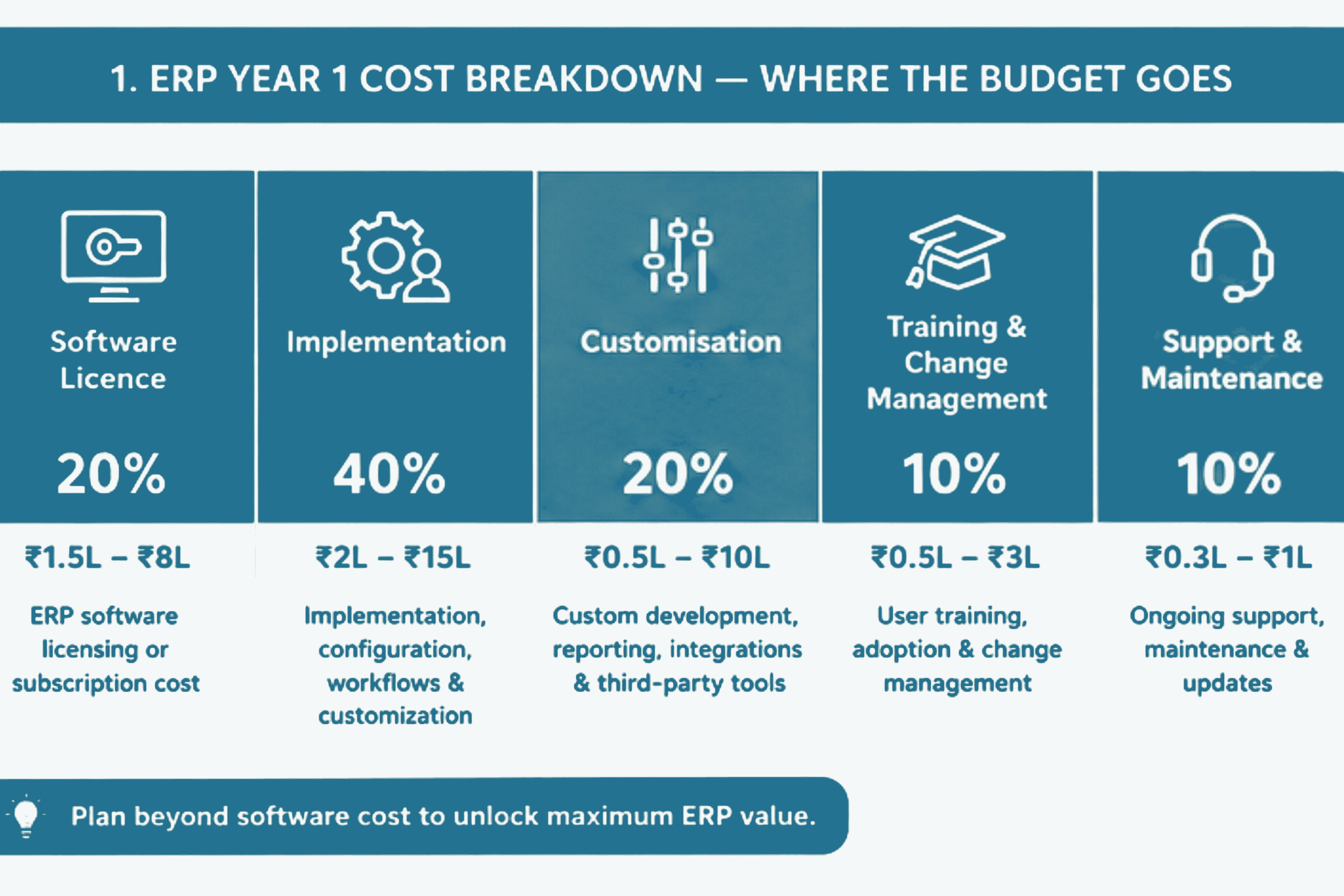
ERP Year 1 Cost Breakdown — Where the Budget Goes
Get a Budget Estimate Get a practical ERP budget range based on users, locations, modules, and implementation complexity.
Breaking Down ERP Costs: Where Your Money Actually Goes
1. Software Licence Cost: ₹1.5L–₹8L per year
This is often the first number vendors share, but it may represent only one part of the Year 1 investment.
| Licence Model | Typical Cost | Best Consideration |
| Per-user model | ₹8,000–₹15,000 per user per year | Cost increases as users and modules increase |
| Flat licensing model | ₹2L–₹4L annually | May suit businesses expecting user growth |
| Cloud ERP for SMEs | ₹1.5L–₹3L | Lower upfront infrastructure requirement |
| On-premise ERP | ₹3L–₹8L | May suit businesses with specific infrastructure needs |
2. Implementation Cost: ₹2L–₹15L one-time
Implementation can include configuration, business process mapping, data migration, testing, user acceptance, and go-live support.
| Project Type | Typical Timeline | Typical Implementation Cost |
| Straightforward single-location business | 4–6 weeks | ₹2L–₹4L |
| Manufacturing or workflow-heavy SME | 12–16 weeks | ₹8L–₹15L |
| Multi-location business | 8–12 weeks | Depends on migration, workflows, and integrations |
3. Customisation: ₹50K–₹10L+
Customisation may be needed for GST tracking, approval chains, legacy integrations, specialised reports, industry workflows, or operational controls.
| Customisation Level | Typical Scope | Typical Range |
| Small | Custom fields and a few workflows | ₹50K–₹1L |
| Moderate | Modules, integrations, process rules | ₹2L–₹5L |
| Heavy | Complex APIs, multiple features, advanced workflows | ₹5L–₹10L+ |
Buyer Check: Ask every vendor which requirements can be handled through configuration, which require custom development, and which are not supported. This prevents unclear scope later.
4. Training and Change Management: ₹30K–₹2L
Training affects adoption, reporting quality, process consistency, and ROI.
- Basic training: ₹30K–₹50K
- Role-specific training: ₹80K–₹1.5L
- Extended go-live support: ₹1L–₹2L
5. Annual Maintenance and Support: ₹30K–₹1L per year
Many vendors charge 15–20% of licence cost annually for updates, bug fixes, technical support, and platform maintenance.
6. Infrastructure and Cloud Hosting: ₹20K–₹1L per year
- Standard cloud hosting for up to 50 users: ₹20K–₹40K/year
- Higher-volume or redundant hosting: ₹60K–₹1L/year
- On-premise server: ₹1.5L–₹3L upfront, plus annual maintenance
Hidden Cost of Choosing the Wrong ERP
The cost of a poor ERP decision is not limited to the software budget.
It can also appear as continued manual work, incomplete adoption, delayed decisions, duplicate processes, and operational leakage.
| Business Issue | Operational Impact |
| Spreadsheet dependency | Duplicate data entry, version confusion, slower reporting |
| Inventory errors | Overstocking, stockouts, excess carrying cost, fulfilment issues |
| Delayed approvals | Slower purchasing, billing, production, and exception handling |
| Duplicate work | Teams reconcile the same information repeatedly |
| Poor reporting | Decisions rely on delayed or inconsistent data |
| Production delays | Material availability and planning issues affect output schedules |
| Missed opportunities | Teams cannot identify fast-moving items, customer trends, or margin issues quickly |
Inventory Management Without ERP: ₹5L–₹15L Annual Waste
Without real-time tracking, businesses may overstock slow-moving items and run out of fast-moving products.
A typical small trading business may lose 8–12% of inventory value annually. For ₹1 crore inventory, that can represent ₹8L–₹12L in yearly waste, excluding stockout-related revenue impact.
For live stock visibility, reorder controls, and multi-location tracking, explore [Inventory Management Software].
Billing and Collections Delays: ₹3L–₹8L Annual Drag
When invoices take days to create and follow-ups are manual, collections can slow down.
For a ₹5 crore revenue business with 30-day terms, a 10-day payment delay can create working-capital pressure and interest cost.
Manual Reconciliation: ₹2L–₹4L Annual Labour Cost
Finance teams may spend 5–7 days every month reconciling data manually.
ERP can reduce repetitive reconciliation work and allow teams to focus more on analysis, exceptions, and decision support.
Duplicate Orders and Procurement Waste: ₹2L–₹5L Annual Waste
Without purchase order controls and budget checks, procurement waste can remain difficult to identify.
For ₹1 crore annual procurement, even 3–5% leakage can be material.
For procurement visibility and approval workflows, explore [Purchase Management Software].
Industry-Wise ERP Cost Considerations
| Industry | Key Requirements | Typical Budget Drivers |
| Manufacturing | BOM, MRP, production planning, work orders, quality, batch tracking | Shop-floor workflows, quality controls, integrations |
| Trading | Inventory, billing, GST, sales orders, multi-location stock | Number of SKUs, warehouses, sales channels |
| Distribution | Warehouse operations, route/order visibility, inter-location transfers | Mobile use, warehouse sync, distributor workflows |
| Warehouse | Barcode, bin management, picking, dispatch, stock movement | Devices, integrations, warehouse process design |
| Construction | Project costing, procurement, labour, asset tracking | Project controls, approval workflows, site operations |
| Import Export | Landed cost, multi-currency, compliance, documentation | Currency handling, document workflows, integrations |
For production-led operations, explore [Manufacturing ERP].
For businesses that need procurement, logistics, inventory, and supplier visibility together, explore [Supply Chain Management].
Business Size Budget Guide
| Business Size | Typical Profile | Recommended Year 1 ERP Investment |
| Micro | Under 10 users, one location, standard processes | ₹4L–₹6L |
| Small | 10–20 users, finance plus inventory, basic workflows | ₹4L–₹7L |
| Mid-Sized | 20–40 users, manufacturing or multi-location operations | ₹8L–₹12L |
| Growing Distribution | 40+ users, multiple warehouses and teams | ₹12L–₹15L |
| Enterprise | Complex integrations, governance, multiple entities | Custom scope |
Include a 10–15% contingency for integration discoveries, migration work, and process decisions that emerge during implementation.
Real-World ERP Cost Examples by Business Size
Example 1: Small Trading Company, 12 Users, 2 Locations
Business profile: Retail plus online sales, inventory across two warehouses, billing, and accounting.
| Cost Item | Estimate |
| Cloud ERP licence | ₹1.8L |
| Implementation | ₹3L |
| Training and documentation | ₹40K |
| Inventory and multi-location configuration | ₹80K |
| Total Year 1 | ₹5.2L |
| Year 2 onwards | ₹2.1L annually |
Example 2: Manufacturing SME, 25 Users, 1 Location
Business profile: Production planning, bill of materials, quality tracking, and financial accounting.
| Cost Item | Estimate |
| Cloud ERP with manufacturing modules | ₹2.5L |
| Implementation | ₹6L |
| Workflow and quality configuration | ₹1.2L |
| Training across shifts | ₹80K |
| Quality testing infrastructure | ₹40K |
| Total Year 1 | ₹10.2L |
| 3-Year Total | ₹15.7L |
| Annual savings from Year 2 | ₹8L–₹12L |
| Indicative Payback | 15–18 months |
Example 3: Growing Distribution Company, 40+ Users, 4 Locations
Business profile: Multiple warehouses, sales teams, and complex inter-location inventory.
| Cost Item | Estimate |
| Cloud ERP licence with advanced features | ₹4L |
| Multi-location implementation | ₹8L |
| Warehouse sync and transfer configuration | ₹1.5L |
| Multi-batch training | ₹1.2L |
| Mobile app for warehouse teams | ₹50K |
| Total Year 1 | ₹14.7L |
| 3-Year Total | ₹23.7L |
| Annual savings | ₹15L–₹20L |
| Indicative Payback | 12–14 months |
Cloud ERP vs On-Premise ERP: Real Cost Comparison
| Factor | Cloud ERP | On-Premise ERP |
| Year 1 total | ₹5.5L–₹10.8L | ₹10L–₹21L |
| Year 2+ annual cost | ₹2.3L–₹4.6L | ₹1.3L–₹2.1L |
| Five-year total | ₹13L–₹24L | ₹17L–₹32L |
| Server hardware | Not required | Required |
| Updates | Vendor-managed | Internal planning and upgrade effort |
| Accessibility | Internet-based | Depends on infrastructure |
| Scaling | Easier to add users | May require infrastructure changes |
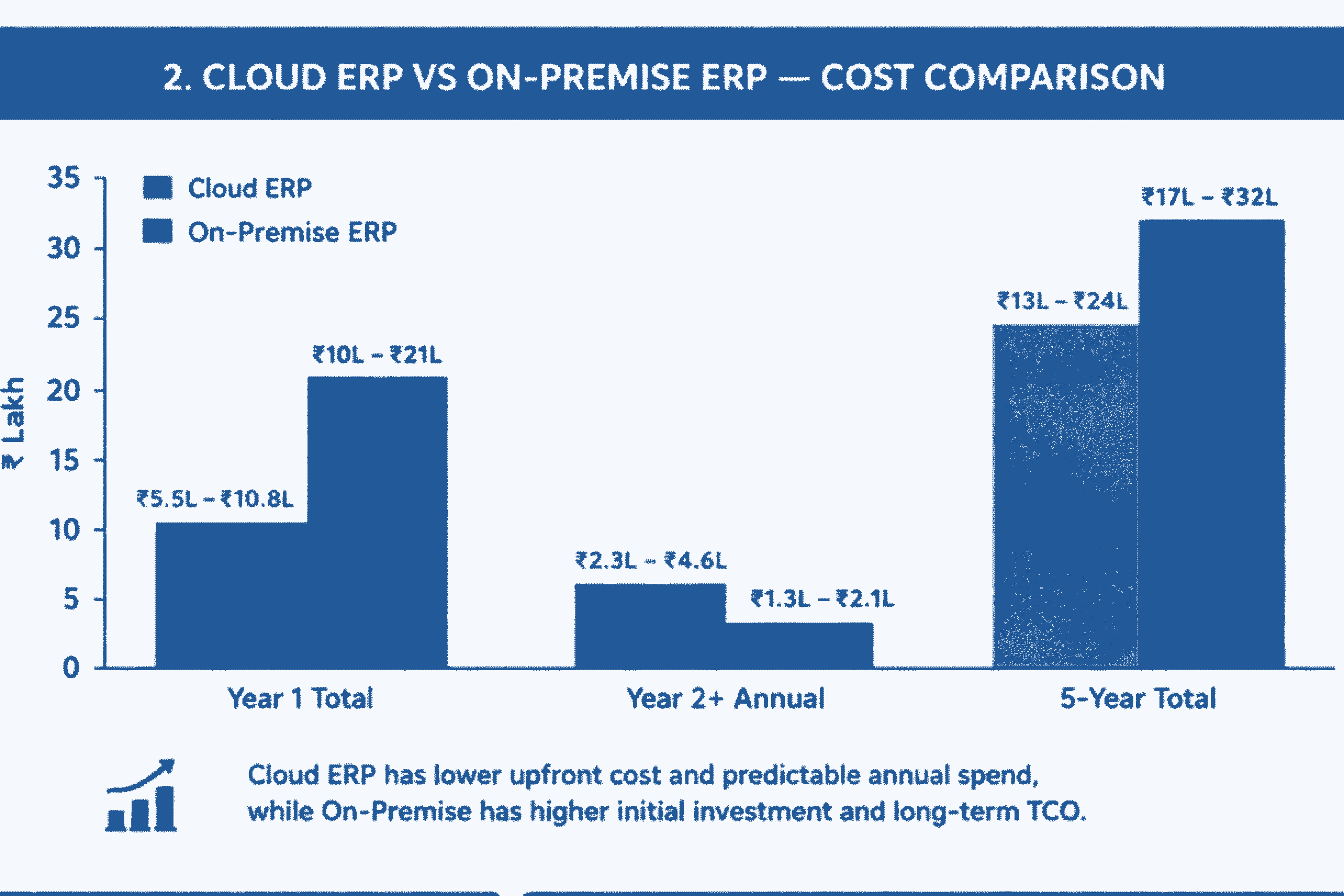
Cloud ERP vs On-Premise ERP — 5-Year Cost Comparison
For many SMEs, cloud ERP can reduce five-year ownership cost and simplify maintenance.
On-premise may still be relevant where offline access, internal infrastructure policy, or specific regulatory needs apply.
ERP Implementation Timeline
| Phase | Typical Duration | Key Outcome |
| Discovery and process mapping | Week 1–2 | Scope, workflows, owners, success metrics |
| Configuration and master-data preparation | Week 2–5 | System setup and clean data |
| Migration and integrations | Week 4–8 | Data validation and connected workflows |
| Testing and role-based training | Week 6–10 | User acceptance and adoption readiness |
| Go-live | Week 8–16 | Controlled launch with support |
| Stabilisation and optimisation | First 30–90 days | Reporting, adoption, process improvements |
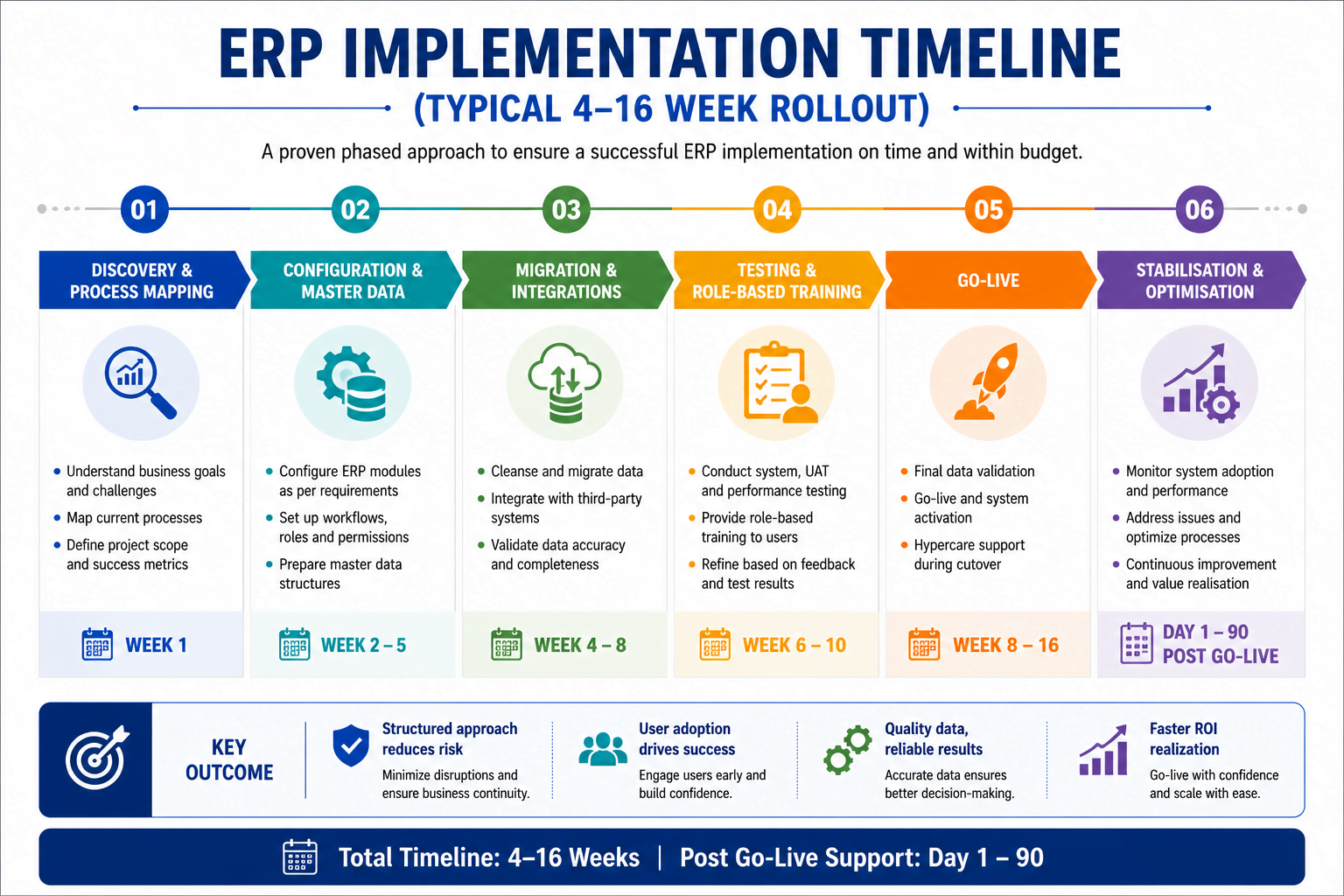
ERP Implementation Timeline — Typical 4–16 Week Rollout
Decision Note: A phased rollout is often safer for businesses with complex operations. Start with finance, inventory, purchase, or a single location; then expand after adoption is stable.
ERP Budget Calculator
Use this estimator as a planning range, not as a final vendor quotation.
Step 1: Base Licence by User Count
- 10–20 users: ₹1.5L–₹2.5L
- 21–40 users: ₹2.5L–₹4L
- 41–60 users: ₹4L–₹6L
- 60+ users: Custom pricing
Step 2: Add Module Complexity
- Finance only: Base cost
- Finance + Inventory: Add ₹30K
- Finance + Inventory + Manufacturing: Add ₹80K
- Finance + Inventory + Manufacturing + CRM: Add ₹1.5L
- Full suite: Add ₹2L
Step 3: Add Implementation Effort
- Simple: ₹2L–₹3L
- Moderate: ₹4L–₹6L
- Complex: ₹8L–₹12L
Quick Examples
- Small trading company: 15 users, finance + inventory, simple implementation = approximately ₹4.2L Year 1
- Growing manufacturing business: 30 users, all modules, moderate implementation = approximately ₹10L Year 1
- Distribution company: 50 users, inventory + CRM, complex implementation = approximately ₹14.5L Year 1
Estimate My ERP Budget See an estimated range before sharing contact details. Request contact details only for a detailed report.
ERP ROI Calculator
ERP ROI should be estimated against current operational costs, not only against software price.
Calculator Inputs
- Annual inventory value
- Annual procurement spend
- Revenue
- Number of finance and operations users
- Current monthly reconciliation hours
- Average collection delay
- Estimated ERP investment
ROI Formula
Estimated annual benefit = inventory improvement + procurement control + labour efficiency + collection improvement + reporting and decision benefit
ROI percentage = (Estimated annual benefit minus ERP investment) divided by ERP investment multiplied by 100
Example: 25-Person Manufacturing SME
| Year | Investment | Savings | ROI | Cumulative Benefit |
| Year 1 | ₹10L | ₹8L | 80% | –₹2L |
| Year 2 | ₹2.5L | ₹11.5L | 460% | +₹7L |
| Year 3 | ₹2.5L | ₹12L | 480% | +₹16.5L |
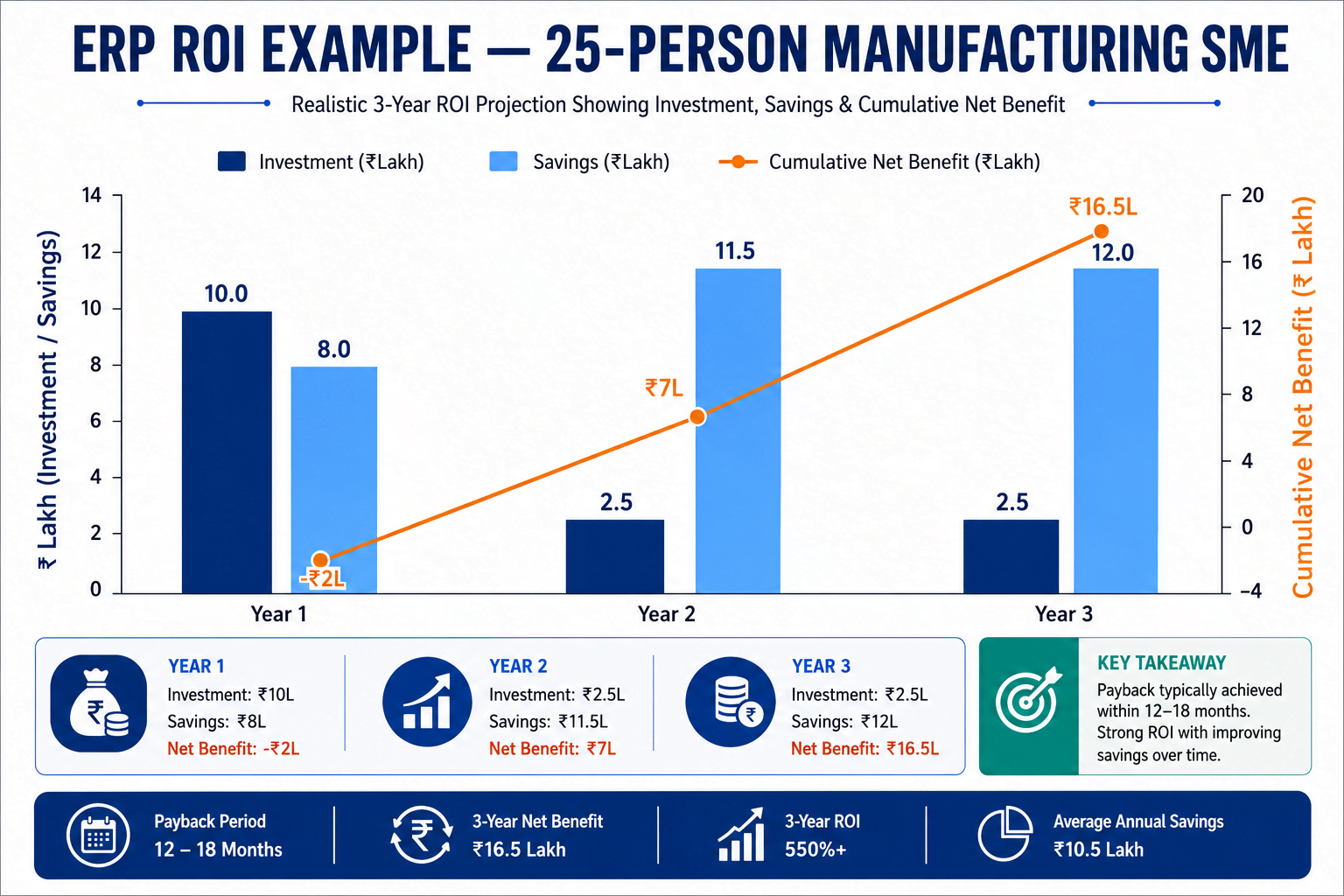
ERP ROI Example — 25-Person Manufacturing SME
Three-Year Summary: Total investment ₹15L, total savings ₹31.5L, net benefit ₹16.5L, overall ROI 110%.
Calculate My ERP ROI Show an estimated result before lead capture. Offer a detailed ROI report after contact submission.
Top ERP Solutions Compared: Which Fits Your Business?
| ERP Solution | Annual Price | Typical Implementation | Best Fit |
|---|---|---|---|
| TallyPrime | ₹30K–₹1L | 2–4 weeks | Accounting-led requirements |
| Zoho One | ₹2L–₹4L | 4–8 weeks | Integrated cloud suite |
| Odoo Cloud | ₹1.5L–₹3.5L | 6–10 weeks | Flexible configuration needs |
| SAP Business One | ₹5L–₹12L | 8–16 weeks | Growing manufacturers |
| Oracle NetSuite | ₹8L–₹20L | 12–20 weeks | Global operations |
| Microsoft Dynamics 365 | ₹3L–₹8L | 8–12 weeks | Microsoft ecosystem users |
| Shivaizer | Flexible | 2–4 weeks | SMEs seeking scalable workflow-led ERP |
| ERP Solution | Business Size | Industry Fit | Deployment Model |
|---|---|---|---|
| TallyPrime | Micro / Small | Trading, services | Desktop / cloud options |
| Zoho One | Small / Mid-sized | Services, sales-led SMEs | Cloud |
| Odoo Cloud | Small / Mid-sized | Trading, manufacturing, distribution | Cloud / on-premise options |
| SAP Business One | Mid-sized | Manufacturing, distribution | Cloud / on-premise |
| Oracle NetSuite | Mid-sized / Enterprise | Multi-entity operations | Cloud |
| Microsoft Dynamics 365 | Mid-sized / Enterprise | Manufacturing, distribution, services | Cloud / hybrid |
| Shivaizer | Small / Mid-sized | Manufacturing, trading, warehouse, distribution | Cloud |
| ERP Solution | Customisation Flexibility | India Compliance | Support Model |
|---|---|---|---|
| TallyPrime | Limited for broader operations | GST-focused | Partner-led |
| Zoho One | Moderate options | India-ready | Vendor / partner |
| Odoo Cloud | High | Depends on localisation | Partner-led |
| SAP Business One | Moderate | Available through partner setup | Partner-led |
| Oracle NetSuite | Moderate | Depends on configuration | Vendor / partner |
| Microsoft Dynamics 365 | High | Depends on configuration | Partner-led |
| Shivaizer | Flexible | GST, TDS, e-invoicing support | India-based support |
TallyPrime may be suitable for accounting-led requirements.
Businesses that need multi-location inventory, workflow automation, production planning, warehouse controls, or integrated operational reporting may require broader ERP capabilities.
Zoho can suit businesses seeking a broad cloud suite. Organisations with specialised manufacturing, distribution, or workflow requirements should validate process fit during evaluation.
Use this table as an initial shortlist. Final selection should be based on your workflows, implementation partner, data migration scope, support model, and total ownership cost.
Talk to an ERP Consultant Get a practical shortlist based on your industry, users, locations, modules, and implementation readiness.
What SMEs Look for in ERP Today
SMEs increasingly prioritise practical implementation and measurable operational value.
- Easy implementation with minimal disruption
- Scalability from 10 users to 100+ users
- Reliable India-based support
- Transparent pricing and scope visibility
- Flexible configuration for real workflows
- GST, TDS, e-invoicing, and statutory reporting support
- Measurable ROI within a defined period
How to Choose the Right ERP: A Practical Buyer Checklist
1. Team Readiness and Technical Capability
- Can the business assign one accountable internal project champion?
- Is there executive sponsorship for adoption?
- Are users ready for structured workflows and consistent data entry?
- Can key users participate in testing and training?
2. Business Process Clarity
- Are key processes documented?
- Are workflows consistent across locations?
- Which requirements are essential for go-live?
- Which requirements can move to phase two?
3. Financial Readiness
- Can the business fund the full Year 1 investment?
- Is a 10–15% contingency available?
- Can the investment be measured against current operational pain?
- Is the Year 2 recurring cost clear?
4. Vendor and Implementation Partner Evaluation
Ask every shortlisted vendor:
- What is included and excluded from implementation scope?
- Who owns data migration and data cleansing?
- How many training sessions are included?
- What is the support SLA after go-live?
- What happens if requirements change?
- Which integrations are included in the quoted price?
- Can the vendor provide relevant industry references?
- What is the expected Year 2 cost?
- What is the escalation process if the project timeline changes?
For a custom estimate or implementation discussion, visit [Contact Us].
FAQ: Your Top ERP Pricing Questions Answered
What is the minimum ERP investment for a small business?
For a simple business with under 20 users, standard workflows, and limited customisation, functional ERP investment may begin around ₹4L–₹6L in Year 1. The final cost depends on implementation, training, migration, and whether inventory, finance, purchase, or CRM modules are required.
Why do manufacturing ERPs cost more than trading ERPs?
Manufacturing may require bill of materials, production planning, work orders, quality control, batch tracking, machine integration, and variance analysis. These requirements can increase configuration effort, customisation needs, and implementation time compared with a straightforward trading workflow.
Is cloud ERP cheaper than on-premise?
For many SMEs, cloud ERP can reduce five-year ownership cost because it avoids server purchases, infrastructure maintenance, version upgrades, and some internal IT overhead. On-premise may still suit businesses with offline, infrastructure, or regulatory requirements.
Should I choose the cheapest ERP to minimise costs?
Not necessarily. A lower licence price can be offset by high customisation, weak implementation, missing functionality, poor support, or low user adoption. Compare total ownership cost, implementation scope, process fit, and Year 2 recurring cost.
What is the typical payback period?
A well-executed ERP implementation may reach payback in 12–18 months. Manufacturing businesses may see earlier benefits through inventory and production improvements. Service businesses may take longer depending on process complexity and the operational areas being improved.
Can I implement ERP with a limited budget of ₹5L?
It may be possible for a simple single-location business with fewer than 10 users and limited customisation. Businesses with multiple warehouses, manufacturing workflows, integrations, or larger teams may need a phased rollout or a higher Year 1 budget.
For SMEs, which flexible and scalable ERP solutions should I consider?
Look for solutions that implement predictably, support GST, TDS, e-invoicing, adapt to relevant workflows, and provide reliable support. Compare vendors based on business fit, implementation quality, migration scope, and long-term ownership cost rather than brand familiarity alone.
How much does ERP cost per month?
For a typical SME with a ₹10L Year 1 investment, the monthly equivalent is approximately ₹83,000. From Year 2, recurring costs may reduce depending on licence, support, hosting, and any additional modules or integrations.
What should be included in an ERP implementation quote?
The quote should clearly cover software licence, implementation scope, process mapping, data migration, integrations, training, testing, go-live support, hosting, support SLA, exclusions, change-request process, and Year 2 recurring costs.
How much should I keep as an ERP contingency budget?
Keep approximately 10–15% of the Year 1 budget for integration discoveries, data-cleansing effort, process changes, additional training, and requirements identified during implementation.
Can ERP be implemented in phases?
Yes. A phased rollout can reduce operational disruption. Businesses may begin with finance, inventory, purchase, or one location, then add manufacturing, warehouse, CRM, or additional branches after the first phase is stable.
How do I compare ERP vendors beyond licence price?
Compare process fit, implementation scope, data migration responsibility, training plan, support SLA, industry references, customisation approach, integration capability, Year 2 cost, and the experience of the implementation partner.
What is the difference between ERP licence cost and total ownership cost?
Licence cost is the recurring software fee. Total ownership cost includes licence, implementation, migration, training, customisation, integrations, hosting, support, internal project time, and future upgrade or expansion requirements.
How long does data migration take for ERP?
Data migration duration depends on the quality, volume, and structure of existing data. Basic master-data migration may take a few weeks, while multi-location historical data, product masters, opening balances, and transaction data can extend the project timeline.
Does GST apply on ERP software costs in India?
Yes. ERP licences, implementation, and support services in India are subject to GST, in the same way as other software and professional services. Vendor quotes are typically shown pre-GST, so confirm the applicable rate before finalising your budget.
Is buying a ready ERP different from custom ERP development cost?
Yes. This guide covers the cost of buying and implementing an established ERP platform (₹1.5L–₹50L range). Fully custom-built ERP development is a separate exercise, generally priced by development hours and scope, and is usually considered only when no configurable platform fits a highly specialised workflow.
Final ERP Decision Framework
ERP pricing in India becomes more predictable when the full scope is visible.
| Business Type | Typical Year 1 Investment | Typical Ongoing Cost | Indicative Payback |
| Small trading business, 10–20 users | ₹4L–₹7L | Around ₹1.5L annually | 12–15 months |
| Manufacturing SME, 20–40 users | ₹8L–₹12L | ₹2.5L–₹4L annually | 15–18 months |
| Growing distribution business, 40+ users | ₹12L–₹15L | ₹4L–₹6L annually | 12–14 months |
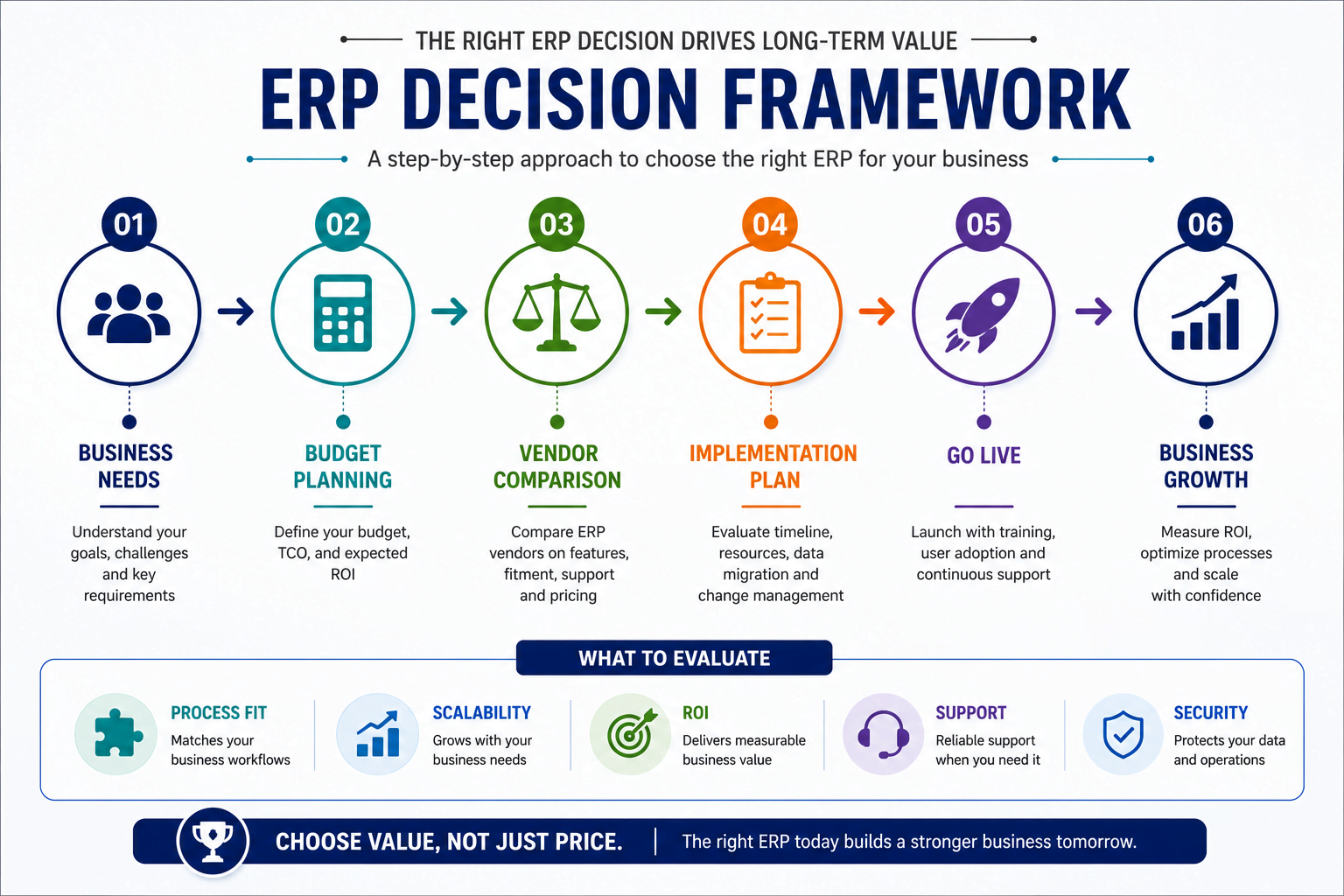
Final ERP Decision Framework
The right ERP is not automatically the cheapest.
It is the system that fits your workflows with minimal unnecessary customisation, has a clear implementation plan, supports user adoption, and gives the business a realistic path to measurable operational improvement.
Book an ERP Assessment
A useful ERP discussion should focus on actual workflows: inventory, purchase approvals, production planning, reporting, finance, warehouse movement, and growth plans.
Book ERP Assessment Get a practical ERP budget range, implementation approach, and module recommendation based on your business.
Contact Us Discuss your current operational challenges with the Shivit ERP team.