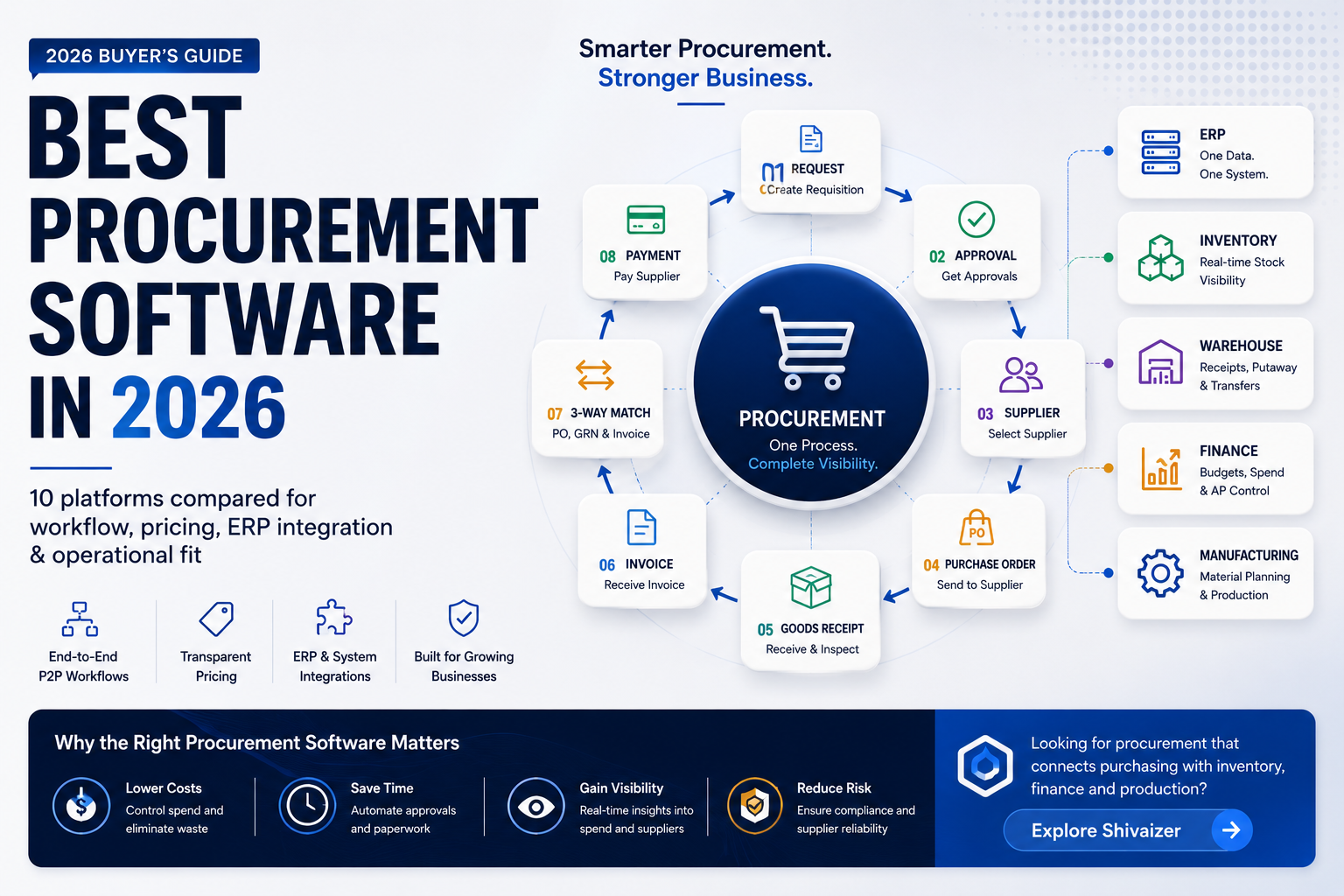
Best Procurement Software in 2026: 10 Purchase Management Systems Compared
Editorial disclosure. Shivaizer is developed by Shivit Technologies, the publisher of this guide, and is included alongside competing platforms under the same criteria. Competitor pricing and capability information is drawn from vendors’ own published pricing pages and product documentation, supplemented where noted by independent software directories and third-party contract benchmarks, and was checked in August 2026. Where a vendor does not publish a figure, that is stated rather than estimated. Shivaizer’s capability entries are publisher-supplied, are labelled as such throughout, and have not been independently verified. Pricing and packaging in this category change frequently — confirm current details with each vendor before purchasing.
Most procurement software comparisons answer the wrong question. They rank platforms against each other as though procurement were one uniform requirement. It isn’t.
A 40-person services business that wants purchase requests approved before money leaves the account needs almost nothing in common with a manufacturer whose purchasing decisions determine whether a production line runs next Tuesday. Both will search for “best procurement software” and should end up in completely different places.
So the question this guide answers is narrower and more useful:
Which procurement platform fits the way your organisation requests, approves, sources, orders, receives, accounts for and pays for goods and services — given the systems you already run?
Ten platforms are compared across procurement workflow depth, supplier management, sourcing, spend control, published pricing and integration with ERP, inventory, warehouse and manufacturing systems. Vendors are listed alphabetically, not ranked.
Quick answer: which platform fits which buyer
| Platform | Best for | Published entry pricing | Typical buyer |
|---|---|---|---|
| Coupa | Enterprise business spend management | Not publicly documented; quote-based, priced per module | Enterprise, multi-module |
| Fraxion | Requisition and budget policy control | Not publicly documented; quote-based | Mid-market |
| GEP SMART | Enterprise source-to-pay | Not publicly documented; quote-based | Mid-market to enterprise |
| Ivalua | Procurement analytics and configurability | Not publicly documented; quote-based | Enterprise |
| Precoro | Structured procurement workflow automation | From $499/month (Core), billed annually | SMB to mid-market |
| Procurify | Pre-spend budget control | Not publicly documented; quote-based | Mid-market |
| Ramp | Intake-to-pay and card-led spend management | Free tier; Plus from $15/user/month plus platform fee | Finance-led teams |
| Shivaizer | Procurement inside ERP, inventory and manufacturing operations | Not publicly documented; quote-based | SME to mid-market, inventory-heavy |
| Tipalti | Procurement with AP and global supplier payments | From $99/month platform fee plus per-transaction charges | Mid-market to enterprise |
| Tradogram | Modular purchasing you can scale up | From $99/month (Essentials); advanced modules are add-ons | SMB to mid-market |
Published entry pricing only. Third-party benchmark ranges are not shown here; see the pricing section. Sources (1)–(13), checked August 2026. Shivaizer entries are publisher-supplied.
Which procurement software should you shortlist?
- Procurement needs to share data with inventory, warehouse receiving, production and finance — ERP-oriented options such as Odoo, NetSuite, Dynamics 365 or Shivaizer.
- Purchasing and accounts payable need to work as one financial process, including cross-border supplier payments — Tipalti.
- You want formal requisition-to-PO workflow without adopting an enterprise suite — Precoro or Tradogram.
- Budget must be enforced before a request becomes an order — Procurify or Fraxion.
- Employee purchasing, corporate cards and expenses are the real problem — Ramp.
- Enterprise spend management across many modules and entities — Coupa.
- Strategic sourcing and full source-to-pay at scale — GEP SMART.
- Procurement analytics, supplier risk and heavy configuration — Ivalua.
How we evaluated procurement software
We screened widely used procurement, purchase management and procure-to-pay platforms and shortlisted ten serving distinctly different buyers. Rather than scoring against a single feature checklist, we assessed each against six criteria that change shortlisting decisions:
- Procurement workflow depth— requisitions, approval routing, purchase orders, receiving, invoice matching.
- Supplier management and sourcing— vendor master data, onboarding, performance, RFQ and catalogue capability.
- Spend and financial control— budgets, committed spend, three-way matching, analytics.
- Operational integration— ERP, accounting, inventory, warehouse and production systems.
- Commercial transparency— whether pricing is published, and what the published figure actually covers.
- Business fit— company size, deployment model and implementation effort.
How this guide handles evidence
Because procurement pricing and packaging are inconsistently published, it is worth being explicit about where each statement comes from.
- Vendor-documented: the capability or price appears on the vendor’s own pricing page or product documentation. Prices are quoted only in this form.
- Third-party contract benchmark or independent market estimate: a range compiled by an independent source from buyer contract data, used only where a vendor publishes nothing. These are labelled in the text and are not vendor pricing.
- Independent review aggregate: scores and reviewer-segment data from public software directories, cited with the caveat that they reflect a point in time.
- Publisher-supplied: Shivaizer capability statements, provided by Shivit Technologies and not independently verified.
- Not clearly stated: the capability is neither confirmed nor ruled out by available documentation. This is recorded as an open question for the buyer rather than treated as absence.
Several procurement pricing figures in wide circulation in 2026 are either out of date or are third-party models presented as vendor prices. Where a capability depends on plan, module or integration, this guide says so rather than marking a tick.
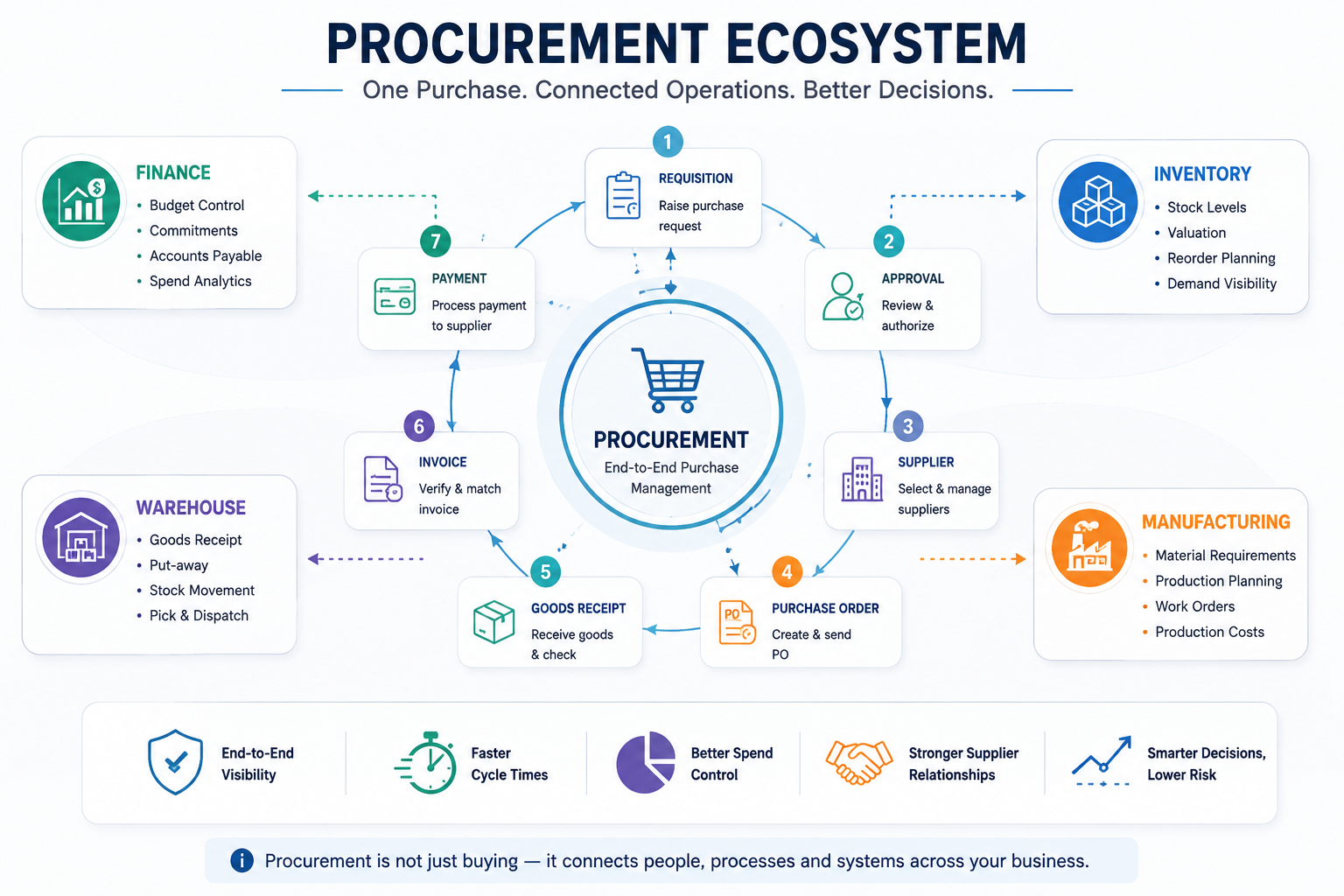
10 procurement software platforms worth evaluating in 2026
Listed alphabetically. This is not a ranked list — each platform addresses a different procurement problem. Statements about competing platforms are drawn from vendor documentation and independent sources; statements about Shivaizer are supplied by the publisher and labelled accordingly.
Coupa — best for enterprise business spend management
Best for: large organisations consolidating procurement, invoicing, expenses and payments into one spend platform.
Coupa is built around business spend management rather than purchase-order processing. Its functional areas — procurement, sourcing, contracts, invoicing, expenses, payments and supply chain planning — are licensed as separate modules. This matters commercially: cost depends on which modules are activated, transaction volume and entity count, rather than on a simple seat price.
Pricing. Coupa does not publish pricing; its public directory listing directs buyers to sales. (4) As a third-party contract benchmark rather than vendor pricing, independent analysis of buyer contract data indicates annual subscriptions in the region of $50,000 to $150,000 for smaller and mid-market configurations, rising substantially for enterprise multi-module deployments. (3) Per-user figures for Coupa that appear in some comparison content should be treated with caution, as they do not reflect the module-based basis on which the platform is sold.
Limitations. Buyers should scope implementation and internal ownership carefully. At the time of checking, independent review aggregates placed Coupa’s ease-of-setup and support scores below those of the mid-market platforms in this comparison, with a predominantly enterprise reviewer base. (4) Coupa is not positioned as an operational ERP: inventory, warehouse and production data sit in other systems and are integration-dependent.
Consider another platform if: you are a smaller organisation, or procurement decisions depend on live stock and production data held in another system.
Fraxion — best for requisition and budget policy control
Best for: mid-sized organisations that need purchasing policy enforced before a request becomes an order.
Fraxion’s centre of gravity is the requisition: a request is checked against departmental budget and purchasing policy before it moves, then routed through an approval chain with a retained audit trail. Published capabilities include requisitions with custom approvals, budget and policy control, purchase order automation, receiving, invoice matching, AI-assisted AP automation, spend analytics, PunchOut and PunchIn, internal catalogues, expense management and a mobile app. (5)
Two details help organisations with distributed approvers: approvals can be completed on mobile or through Microsoft Teams, and Fraxion states on its own pricing page an implementation window of typically one to three months, depending on ERP, user count and configuration requirements. (5) Few vendors in this category publish an implementation estimate at all, which makes the figure useful for comparison even though it is vendor-stated rather than independently measured.
Pricing. Not publicly documented; quote-based. Third-party estimates for Fraxion vary widely and are not reproduced here. (5)
Consider another platform if: inventory management, material planning or production-linked purchasing are central requirements; these are not documented as core Fraxion capabilities and would need vendor confirmation.
GEP SMART — best for enterprise source-to-pay
Best for: mid-market and enterprise procurement teams where sourcing, not purchase-order processing, is the strategic activity.
GEP SMART is built around source-to-pay: supplier discovery and analysis, sourcing events, contracting, procurement execution and spend analytics on one platform rather than a stack of separately acquired modules. It integrates with major enterprise platforms including SAP and Oracle — which matters, because organisations at this scale rarely replace their financial system to improve procurement. (6)
Pricing. Not publicly documented; quote-based. (6)
Limitations. The platform is positioned for large, complex sourcing operations, which makes it a heavier fit for a company that mainly needs requisitions and approvals. Buyers whose priority is downstream procure-to-pay execution rather than sourcing should verify module depth directly with the vendor, as public documentation emphasises the sourcing side of the suite. (6)
Consider another platform if: you want a lighter operational purchasing system, or your spend is concentrated with a small, stable supplier base.
Ivalua — best for procurement analytics and configurability
Best for: large organisations consolidating procurement data across many entities, locations and departments.
Ivalua’s distinguishing capability is its analytics layer: predefined reports covering supplier risk and performance, spend analysis, contract lifecycle and compliance, plus custom report building and KPI tracking, with multi-currency and multi-language support for organisations analysing spend across markets. (7)
Its second characteristic is configurability: the platform is designed to be shaped to an organisation’s processes rather than the reverse. This suits organisations with genuinely distinctive procurement processes and dedicated internal ownership of the configuration.
Pricing. Not publicly documented; quote-based. (7)
Consider another platform if: your requirement is straightforward purchase management, or an operational ERP with purchasing built in.
Precoro — best for structured procurement workflow automation
Best for: SMB and mid-market teams formalising purchasing without adopting an enterprise suite.
Precoro covers requisitions, approval workflows, purchase orders, supplier management and invoice processing, with multi-stage approvals configurable to a finance team’s hierarchy. Its most distinctive mechanism is invoice OCR: the engine extracts invoice number, supplier details, issue and due dates, line-item name, price and quantity, tax breakdown and net and gross totals, then drafts the invoice and matches it to the purchase order — which is where the manual effort in accounts payable actually sits. Punchout and punch-in catalogues are supported. (1)(2)
Pricing. Published, and unusually transparent for this category: Core from $499/month and Automation from $999/month, both billed annually, with a custom-priced Enterprise tier and a free trial. (1)(2) The Automation tier is where the AP automation capability sits, so buyers evaluating Precoro for invoice processing should budget against $999 rather than $499. Integrations include QuickBooks Online, NetSuite, Sage Intacct, Xero, Dynamics 365 and Dynamics 365 Business Central. (2)
Limitations. Inventory is not documented as a core capability, and the entry price may be high for very small teams. Independent review data at the time of checking showed a predominantly mid-market reviewer base. (2)
Consider another platform if: purchasing depends on stock positions, warehouse receiving or production planning.
Procurify — best for pre-spend budget control
Best for: finance teams that want to control committed spend before money leaves the business.
Procurify’s design principle is that overspend is cheaper to prevent than to reconcile. When someone raises a purchase request they see the remaining balance for that department or category at that moment, and threshold-based routing escalates anything that would breach a limit rather than letting it through. Downstream, three-way matching across purchase order, receipt and invoice keeps approved and actual spend aligned. (8)
Pricing. Not publicly documented. Public directory listings show no pricing plans and direct buyers to contact sales. (8) Monthly figures for Procurify that appear in comparison content are independent market estimates rather than vendor pricing and should be treated as such.
Limitations. Inventory management is not positioned as a core capability, which is a material consideration for distributors and manufacturers. Integration with accounting and purchasing systems including NetSuite, QuickBooks and Amazon PunchOut is documented as available via API. (8)
Consider another platform if: you need stock tracking alongside purchasing, in which case Tradogram’s inventory module or an ERP-based approach may fit better.
Ramp — best for intake-to-pay and card-led spend management
Best for: finance-led organisations where the problem is uncontrolled employee purchasing rather than formal procurement.
Ramp approaches procurement from the spend side. Requests are captured at the moment of intent — what, why, which vendor, how much — routed for approval with that context attached, then converted to a purchase order and carried through invoice and payment as one linked transaction supporting three-way matching. Cards, expenses, AP and procurement sit in one platform, which is the point: for many companies the leak is card spend and unmanaged vendors, not requisition workflow.
Pricing. A free tier covers cards, expense management, AP and vendor tracking. Plus is documented at $15 per user per month plus a platform fee scaled to company size, with Enterprise custom-priced. (9) Procurement automation and purchase-order management are associated with the Plus tier, though sources differ on whether procurement is included at that tier or licensed as an add-on. (9)(10) Buyers should confirm the scope in writing before signing.
Limitations. Ramp is not positioned primarily as a sourcing, contract lifecycle or supplier performance platform, and inventory is not documented as a capability. Buyers with those requirements should compare it directly against a dedicated procurement platform. (10)
Consider another platform if: you buy physical goods, or you need sourcing and supplier performance management.
Shivaizer — procurement within ERP, inventory and manufacturing operations
Particularly relevant for: manufacturers, distributors, traders and inventory-heavy SMEs and mid-market businesses, where a purchasing decision also affects stock, production and cash commitments.
Shivaizer is positioned as an ERP-oriented platform in which procurement operates alongside other operational functions rather than as a standalone purchasing application. According to the publisher’s product documentation, its procure-to-pay capability covers requisitions, multi-level approvals, supplier management, purchase orders, goods receipt, invoice verification and spend controls, operating in the same environment as inventory, finance and related ERP functions. (12) These statements are publisher-supplied and have not been independently verified.
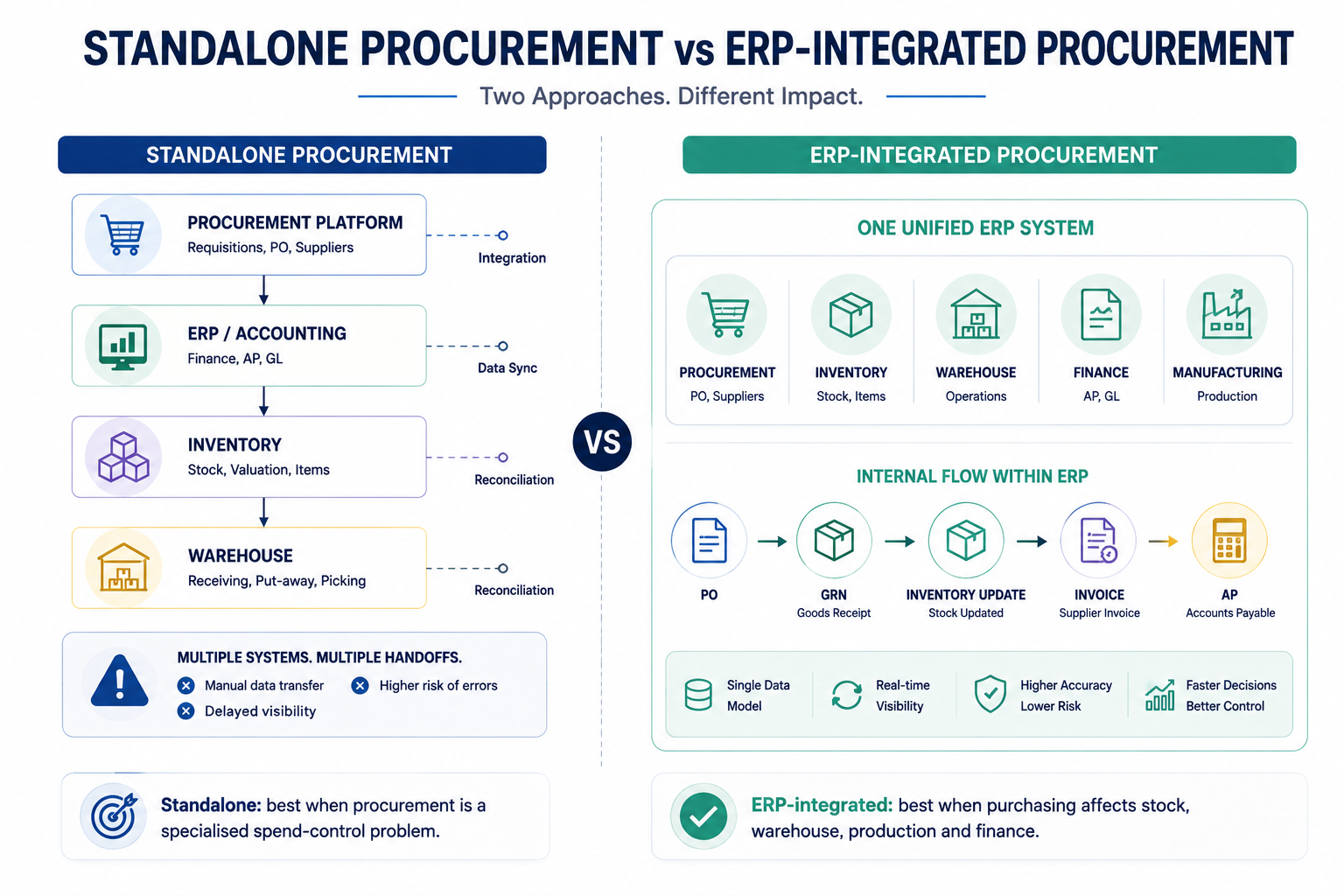
The important question is what happens after the purchase order. In a standalone procurement platform, a goods receipt is a procurement record, while the stock update and the payable are typically events in other systems that must be reconciled. Where procurement and operations share a single data model, a receipt is intended to update the stock position and the payable together:
For manufacturers, the same chain extends upstream into material planning, where purchasing decisions affect production continuity:
According to the publisher’s documentation, Shivaizer also handles India-specific requirements within the purchase workflow, including GST-compliant purchasing and vendor tax information, alongside inventory and production planning. (12) This has not been independently verified. Of the ten platforms reviewed, the standalone procurement platforms do not document inventory or manufacturing workflows as core capabilities, while the ERP purchasing modules do. Buyers should ask any shortlisted vendor, including Shivaizer, to demonstrate the specific GST workflows they require — GSTIN validation, HSN and SAC handling, e-invoicing and e-Way Bill — rather than relying on a general statement of GST support.
Pricing and deployment. Not publicly documented; quote-based. Deployment options and typical implementation duration are not stated in the public product documentation reviewed for this guide, and buyers should request both in writing, together with a demonstration of the workflows described above, before shortlisting.
Limitations. Shivaizer is positioned as a global ERP platform with integrated procurement, inventory, finance and operational workflows, rather than as a dedicated global supplier-network or strategic-sourcing platform. Organisations whose primary requirements are supplier discovery at scale, complex sourcing events, supplier risk management or consolidated multi-module spend management are likely to find Coupa , GEP SMART or Ivalua a stronger fit. Because Shivaizer’s capability entries in this guide are publisher-supplied rather than independently verified, buyers should apply the same demonstration-based scrutiny to it that they would apply to any other vendor on the list.
Consider another platform if: procurement is primarily an indirect, services-based spend problem with no physical inventory involved, or global strategic sourcing is the central requirement.
Tipalti — best for procurement with AP and global supplier payments
Best for: mid-market and enterprise finance teams paying suppliers across multiple countries and legal entities.
Tipalti connects purchasing to the payment rail. Requests are captured on structured intake forms, validated against budget controls, routed by rules-based approval, converted to purchase orders, then matched two- or three-way against receipts and invoices before payment. What differentiates it is the layer beneath: supplier onboarding with tax form validation, multi-entity infrastructure and currency conversion, so an approved purchase can be paid to a supplier in another jurisdiction with the compliance handling attached. It lists more than 40 integrations including NetSuite, QuickBooks Online, Acumatica, Dynamics 365 Business Central and Epicor. (11)
Pricing. Documented as a platform fee from $99/month (Select), with Advanced at $199/month and a custom-priced Elevate tier. The platform fee is one component: Tipalti also states that charges vary with transaction volume and payment method. (11) As a third-party contract benchmark rather than vendor pricing, independent analysis of buyer contracts indicates a core platform cost in the region of $15,000–$25,000 per year for smaller deployments, rising considerably once payment processing, additional modules and multi-entity configuration are included. (11) The published entry figure should therefore be read as a starting point rather than a total cost.
Limitations. Inventory, warehouse and manufacturing workflows are not part of its documented scope. Buyers should verify reporting capability and the effort involved in supplier compliance and onboarding during evaluation, as both are recurring themes in independent user reviews. (11)
Consider another platform if: your suppliers are largely domestic and your procurement requirement is operational rather than financial.
Tradogram — best for modular purchasing you can scale up
Best for: small and mid-market businesses that want to start with purchase orders and add procurement capability as they grow.
Tradogram’s core plan covers purchase orders, supplier management, AP invoices, payments, OCR document capture, expense management and mobile apps. Its more advanced capability — requisitions, receiving (GRN), sourcing RFx, real-time budget tracking, contract management, inventory management, custom approval routing, custom reporting and multi-entity support — is sold as add-on modules on the entry plan and included in higher tiers. (13)
Its supplier performance mechanism is worth noting: supplier records can be scored on delivery timing, invoice accuracy and pricing compliance, building historical data that can be checked before placing a further order. (13)
Correction worth knowing. Tradogram’s pricing and packaging changed during 2026, and a number of comparison pages still describe the earlier structure. At the time of checking in August 2026, the plans documented on Tradogram’s own pricing page were Essentials at $99/month (or $950.40/year billed annually, reflecting a 20% annual discount), Premium at custom quote for 20 or more users, and Scale at custom quote with unlimited users. A free tier is no longer listed, and the monthly figures repeated in some older comparisons do not appear on the current pricing page. (13) Buyers working from secondary sources should confirm directly with the vendor.
Pricing detail that changes the comparison. Because requisitions are listed as an add-on rather than a core module on the Essentials plan, a business adopting Tradogram specifically for requisition-to-PO workflow should price the modules it actually requires rather than the entry figure. PunchOut, ERP and accounting integrations, single sign-on and API access are also listed as add-ons across plans. Tradogram’s pricing page describes an implementation path reaching go-live within one to four months, and displays SOC, ISO 27001, PCI DSS and GDPR compliance marks. (13)
Consider another platform if: you need enterprise sourcing at scale, or manufacturing material planning; the documented inventory module addresses stock-level tracking rather than MRP, and material planning capability would need vendor confirmation.
ERP purchasing modules worth evaluating alongside these
With the exception of Shivaizer, every platform reviewed above is a standalone procurement or spend application. Where the requirement is operational, a complete comparison set should also include ERP purchasing modules, in which procurement and inventory data sit in the same system by design:
- Odoo — modular ERP where Purchase, Inventory and Manufacturing apps share one data model; reordering rules can generate draft purchase orders from stock minimums.
- NetSuite — cloud ERP with purchasing, vendor management, inventory and financials in one environment.
- Microsoft Dynamics 365 — procurement and sourcing within a broader supply chain and finance estate.
- Zoho Procurement — structured procurement workflows for smaller organisations already inside the Zoho ecosystem.
- Bellwether — long-established purchasing software with inventory features, aimed at small and mid-sized businesses.
Pricing and detailed capability ratings are not published for these five, because they were not checked to the same standard as the ten platforms reviewed above. They are listed so the shortlist is complete, not to suggest they are weaker options. Where procurement and inventory need to share data, at least one of them merits evaluation alongside Shivaizer.
Procurement software capability comparison
Requisitions, approvals, purchase orders and supplier records are present across every platform reviewed, so comparing those adds little. What follows covers the capabilities that differ between products, using a consistent evidence grading rather than ticks.
- Vendor-documented — stated in the vendor’s own pricing page or product documentation.
- Depends on plan/module — documented, but tied to a specific tier or a separately licensed module.
- Integration-dependent — delivered by connecting to another system rather than natively.
- Not clearly stated — neither confirmed nor ruled out by available documentation; treat as a question for the vendor.
- Publisher-supplied — stated by Shivit Technologies for Shivaizer; not independently verified.
| Platform | Sourcing / RFQ | Receiving (GRN) | Invoice matching | Inventory | Manufacturing / MRP | ERP & accounting integration |
|---|---|---|---|---|---|---|
| Coupa | Depends on module | Vendor-documented | Depends on module | Integration-dependent | Integration-dependent | Vendor-documented |
| Fraxion | PunchOut & catalogues documented | Vendor-documented | Vendor-documented | Not clearly stated | Not clearly stated | Vendor-documented |
| GEP SMART | Vendor-documented | Vendor-documented | Vendor-documented | Integration-dependent | Integration-dependent | Vendor-documented |
| Ivalua | Vendor-documented | Vendor-documented | Vendor-documented | Integration-dependent | Integration-dependent | Vendor-documented |
| Precoro | Punchout & punch-in documented | Vendor-documented | Vendor-documented (OCR) | Not clearly stated | Not clearly stated | Vendor-documented |
| Procurify | PunchOut documented | Vendor-documented | Vendor-documented (3-way) | Not clearly stated | Not clearly stated | Integration-dependent (API) |
| Ramp | Not clearly stated | Vendor-documented | Vendor-documented (3-way) | Not clearly stated | Not clearly stated | Depends on plan |
| Shivaizer | Publisher-supplied | Publisher-supplied | Publisher-supplied | Publisher-supplied | Publisher-supplied | Publisher-supplied |
| Tipalti | Not clearly stated | Vendor-documented | Vendor-documented (2- & 3-way) | Integration-dependent | Not clearly stated | Vendor-documented |
| Tradogram | Depends on plan/module | Depends on plan/module | Vendor-documented | Depends on plan/module | Not clearly stated | Depends on plan/module |
“Not clearly stated” records an absence of documentation, not an absence of capability — several of these may be available and simply undocumented in the sources reviewed. Availability can also depend on edition, module and configuration. Confirm each requirement against current vendor documentation, and ask for a demonstration, before purchase. Checked August 2026.
ERP-native procurement vs standalone procurement software
This decision is often made implicitly, yet it removes more unsuitable products from a shortlist than any feature checklist.
When standalone procurement software is the right choice
A dedicated procurement platform makes sense when procurement is a distinct discipline rather than an operational dependency:
- Your ERP or accounting system is stable and you do not want to replace it.
- Spend is mostly indirect — services, software, facilities, travel — rather than materials.
- You need specialised sourcing, supplier risk or spend analytics that no ERP module offers.
- Supplier relationship management is itself a strategic function with dedicated staff.
- The bottleneck is approval discipline and policy compliance, not stock accuracy.
Coupa, GEP SMART, Ivalua, Precoro, Procurify, Fraxion, Ramp and Tipalti each address versions of this model, though they differ substantially in scale and emphasis.
When ERP-integrated procurement makes more sense
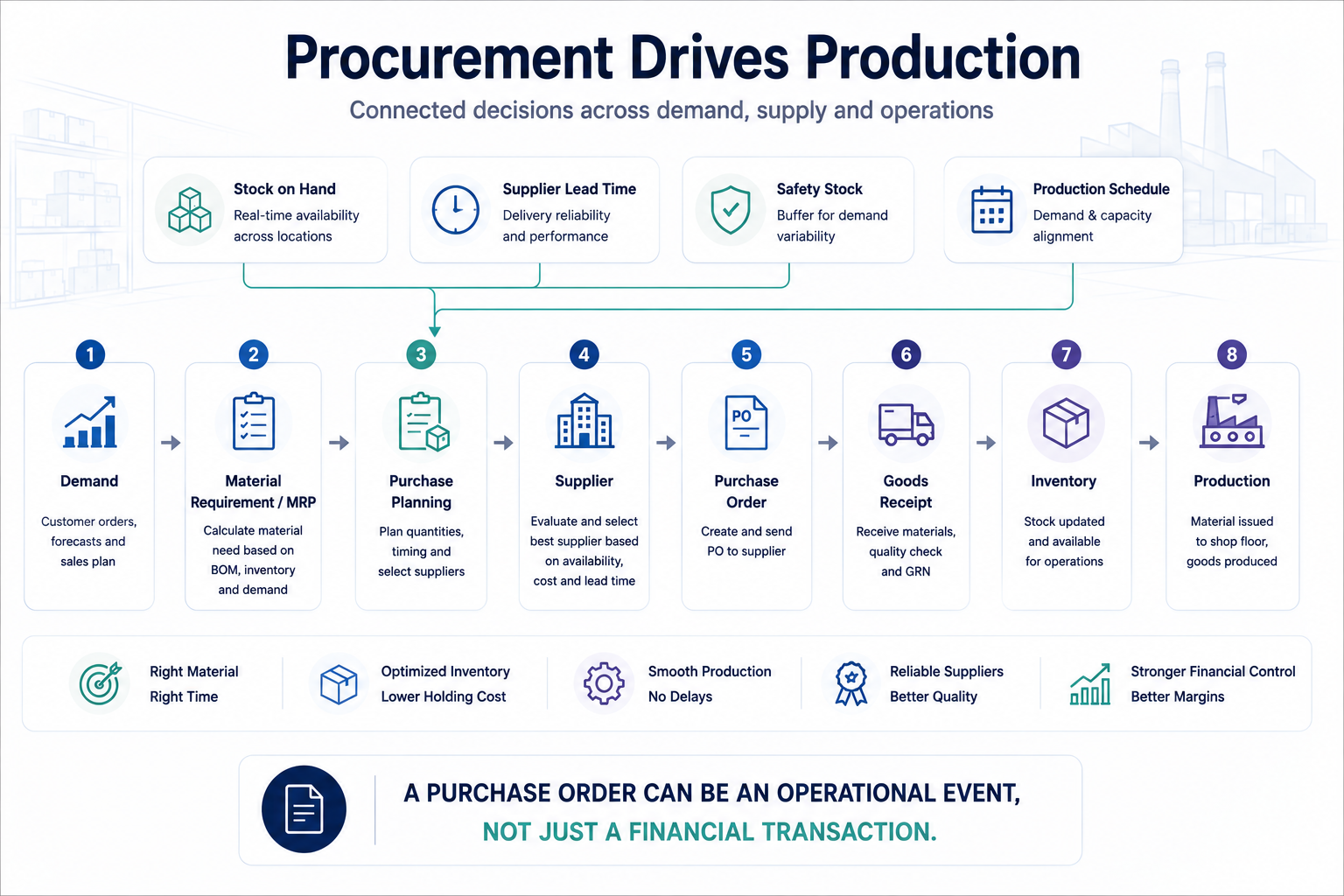
ERP-oriented purchasing tends to be the stronger choice when a purchase order is an operational event as well as a financial commitment — where buying affects inventory, warehouse receiving, material planning, production scheduling, sales fulfilment or multi-location stock.
The test is concrete. Follow one transaction:
Where those five events sit in three systems, reconciliation is usually manual and scales with transaction volume rather than company size. Where they sit in one system, the transaction is a single record. This is the substantive case for ERP-oriented procurement, and the reason Odoo, NetSuite, Dynamics 365 and Shivaizer warrant consideration alongside the standalone platforms
The integration cost buyers underestimate
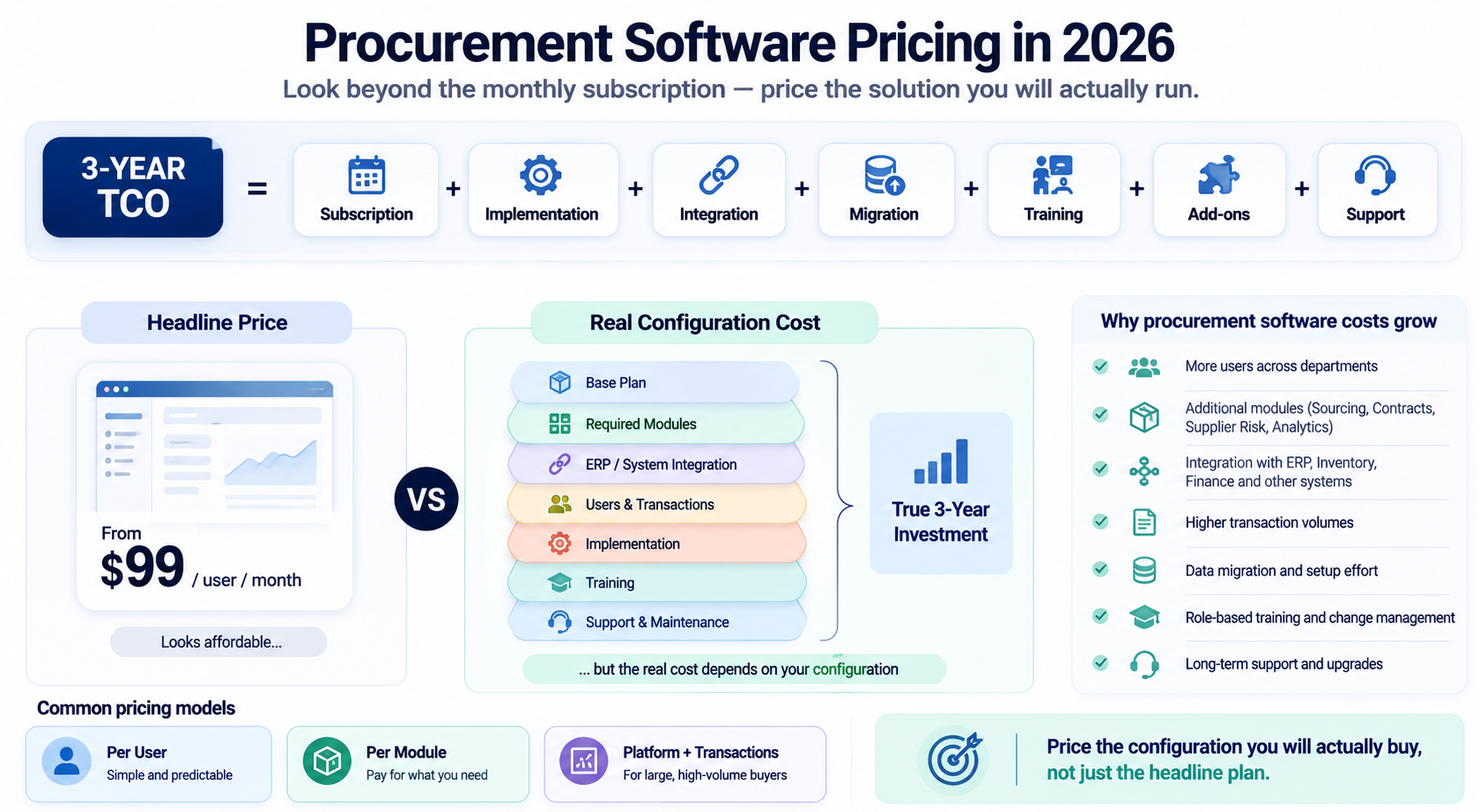
Subscription price is a poor proxy for total cost. A cheaper platform can end up more expensive once you fund:
- ERP and accounting integration — including whether it is real-time, API-based, scheduled or manual.
- Supplier and item-master data migration.
- Approval hierarchy and policy configuration.
- Historical purchase order import.
- User training and workflow redesign.
- Ongoing maintenance of the integration when either system updates.
At least one platform reviewed lists ERP and accounting integration as a paid add-on, and prices much of its procurement workflow as separately licensed modules. Neither is visible in a headline price, which is why the configuration rather than the entry tier should be quoted.
What is procurement software?
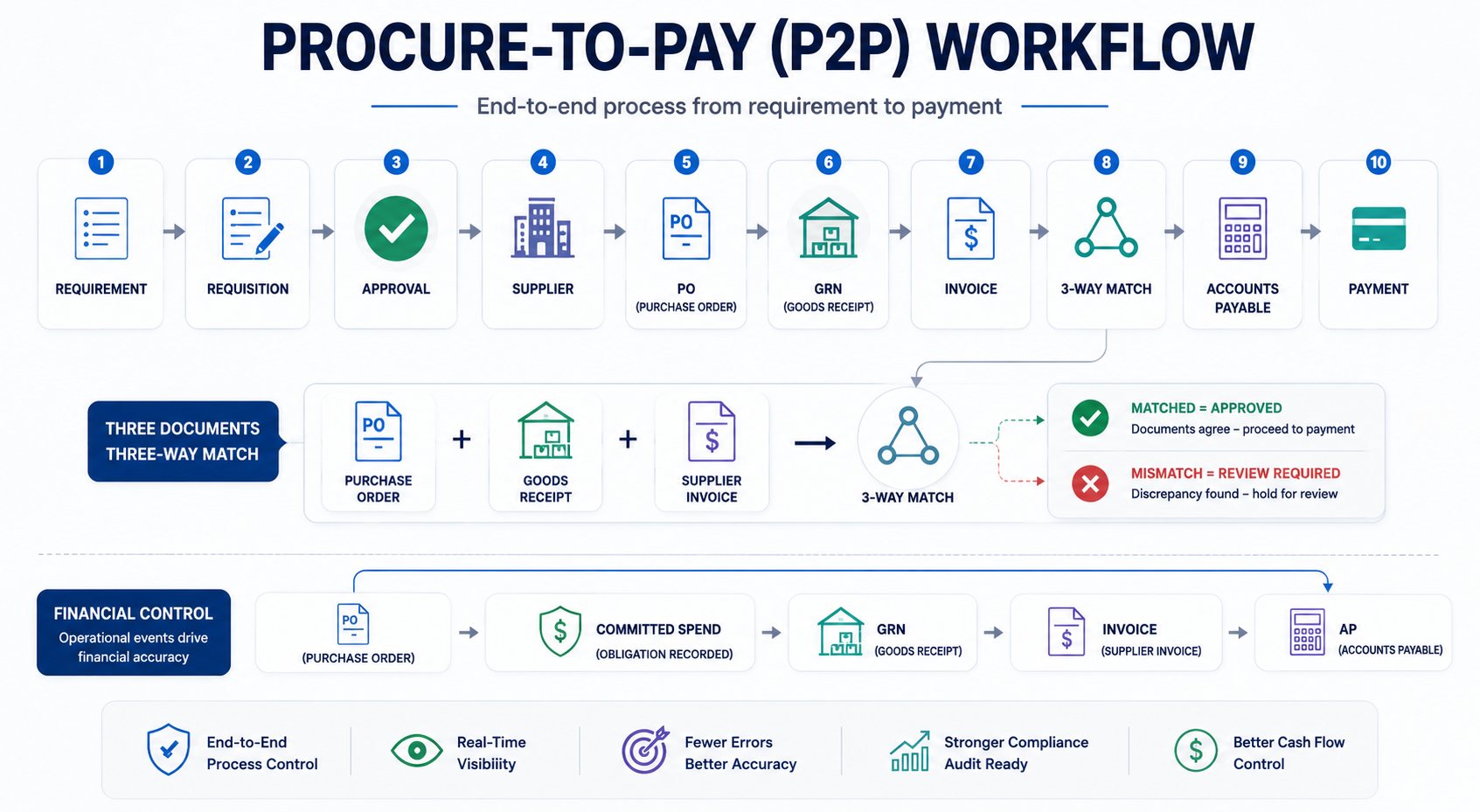
Procurement software manages and automates the process of obtaining goods and services — from the internal request and its approval, through supplier selection, purchase order, receipt and invoice, to payment. Depending on the platform it may also cover sourcing, contract management, budget control, spend analytics and ERP, accounting, inventory and warehouse integration. It is also referred to as eProcurement, a procurement management system
A purchase order system is narrower — it creates and tracks purchase orders. A procurement management system manages what happens before, during and after the purchase order.
Procurement vs purchasing vs purchase management software
Purchasing is the transaction: requesting, ordering, receiving and recording. Procurement is broader, adding requirement identification, sourcing, supplier evaluation, negotiation, contracting and supplier performance. Purchase management software generally focuses on the operational purchasing layer rather than upstream sourcing.
Vendors use the labels interchangeably, so compare workflows rather than categories. For a business buying physical materials the distinction is practical: purchasing connects to stock and production, sourcing connects to supplier strategy, and few platforms are strong at both.
What is procure-to-pay (P2P) software?
Procure-to-pay software manages the full cycle from requirement to payment:
A goods receipt note (GRN) records what was actually delivered against the purchase order. Three-way matching compares three documents before payment — the purchase order, the goods receipt and the supplier invoice — confirming that what was ordered, what arrived and what was billed agree. It is the most effective control against overpayment in accounts payable.
What is source-to-pay (S2P) software?
Source-to-pay extends the same cycle upstream into supplier selection:
S2P matters where sourcing decisions carry material value — large volumes, strategic categories, supplier risk, regulated supply chains. For most SMEs those stages happen informally and P2P is sufficient.
What is procurement orchestration?
Procurement orchestration coordinates procurement across systems rather than housing it in one application: intake, approval, sourcing, supplier records, ERP, purchase order, receiving, accounts payable and analytics may each sit in a different tool. Orchestration routes a request through them coherently. It emerged as procurement stacks fragmented, and it is where AI is being applied first.
What procurement software does — and what to verify
Requisitions, approvals, purchase orders and supplier records exist everywhere. These are the areas where implementations tend to succeed or quietly fail.
Requisitions and approval workflows
Verify configurable approval rules, department and cost-centre routing, value thresholds, project-based approvals, multi-level chains, mobile approval, and a retained audit trail.
Supplier management, onboarding and vendor master data
Verify onboarding workflow, vendor master governance, tax information capture, approved-supplier lists, compliance document expiry, performance history and duplicate-vendor prevention. The chain is continuous: sourcing produces an onboarded supplier, onboarding produces vendor master data, and vendor master data determines who may appear on a purchase order:
Sourcing, RFQ, catalogues and punchout
Verify RFQ and RFP support, quotation comparison, sourcing events, contract records and expiry alerts.
Two capabilities are worth naming because they cut manual entry and are unevenly supported. Punchout lets a buyer browse a supplier’s catalogue from inside the procurement system and return with a populated requisition; punch-in works in reverse, letting a supplier submit into the buyer’s system. Precoro, Fraxion, Procurify and Tradogram all support some form of it — Tradogram as a paid add-on. (1)(5)(8)(13)
Purchase orders, goods receipt and three-way matching
For physical goods the purchase order starts an operational sequence rather than ending a procurement one:
Verify partial receipts, over- and under-delivery handling, quality-check status, and whether a receipt updates stock or only records a procurement event. This distinction is the clearest dividing line between procurement platforms and operationally integrated systems.
Budget control, committed spend and landed cost
Good procurement software shows not only what has been spent but what has been committed. An approved purchase order is an obligation before any invoice arrives, and visibility into committed spend is what lets finance forecast rather than reconcile.
Importers should ask about landed cost — whether freight, insurance, duty and clearing charges can be apportioned to received items so inventory is valued at landed rather than invoice cost. None of the standalone procurement platforms reviewed documents landed cost as a capability; confirm it directly with any vendor where it matters.
Procurement analytics
Useful dashboards cover supplier and category spend, PO volume, approval cycle time, delivery performance, price variance, budget utilisation, open purchase orders and spend under management. Verify whether reports are predefined or genuinely configurable, and whether analytics is included in your tier.
How procurement connects with ERP, inventory, warehouse and production
For businesses buying physical goods, integration depth matters more than feature count. Four connections are worth testing individually in a demonstration.
Procurement and inventory
Purchasing should be informed by stock position, open purchase orders and reorder requirements rather than manual stock checks.
Test whether the system can show a buyer what is on hand, what is on order and what needs replenishing in one view, without an export.
Procurement and warehouse receiving
Where purchasing and warehouse operations are connected, receiving becomes a controlled step rather than a notification: a receipt is matched to a PO line, discrepancies are flagged, quality status is recorded and stock updates on putaway. For distributors and multi-location businesses, this is a significant determinant of ongoing reconciliation effort.
Procurement and finance
The financial chain runs well past the invoice:
“Integrates with accounting” is not a specification. Ask which of those seven events cross the integration boundary, in which direction, and at what frequency.
Procurement and manufacturing
Manufacturing procurement is most useful when it can consume material requirements or planning signals rather than responding only to individual purchase requests:
The criteria that matter here rarely appear in procurement feature lists: reorder points, safety stock, supplier lead times, purchase planning against production schedules, multi-plant procurement, quality checks on receipt and procurement-to-production visibility. None of the standalone procurement platforms reviewed documents MRP or material planning as a core capability; these functions sit in ERP and MRP systems and standalone platforms address manufacturing through integration. Confirm the specific capability with each vendor rather than inferring it from product category.
Best procurement software by business type
No platform suits every segment. The shortlists below follow from the criteria already set out.
| Business type | What matters most | Shortlist |
|---|---|---|
| Small business | Approval discipline, supplier records, PO tracking, accounting integration | Tradogram ($99/mo entry — price the add-ons), Ramp (free tier, if card and employee spend is the problem), Precoro if $499/mo is affordable |
| Mid-market | Multi-level approvals, budget enforcement, spend reporting, multi-location purchasing, ERP integration | Precoro, Procurify, Fraxion, Tradogram; ERP-oriented options including Shivaizer where inventory and production are involved |
| Enterprise | Multi-entity procurement, complex approval hierarchies, sourcing, supplier risk, contract lifecycle, auditability | Coupa (consolidated spend), GEP SMART (source-to-pay), Ivalua (analytics), Tipalti (global supplier payments) |
| Manufacturing | MRP and material requirements, inventory, warehouse receiving, supplier lead times, quality checks, production visibility | ERP-oriented options: Odoo, NetSuite, Dynamics 365, Shivaizer. GEP SMART or Coupa where strategic sourcing outweighs material planning |
| Distribution & wholesale | Purchase planning, live inventory visibility, receiving, reorder management, multi-location purchasing | ERP purchasing modules or Shivaizer; Tradogram with its inventory module for smaller operations; Bellwether for lightweight purchasing plus inventory |
| Construction & projects | Purchase-to-project visibility, project budgets, delivery tracking, subcontractor management, variations | Fraxion, Procurify (project-based budget control); Tradogram on higher tiers. Verify how a project is modelled as a cost object |
| Multi-location / multi-entity | Location-specific approval rules, consolidated reporting, separate legal and financial books | Tipalti (multi-entity in base tier); Tradogram (multi-entity as add-on on entry plan); ERP purchasing modules |
Do not assume multi-location means multi-entity. Multi-location is branch and warehouse stock; multi-entity is separate legal and financial books. Verify how the system models companies, entities, locations, departments and cost centres, and whether consolidated reporting spans them. (11)(13)
Procurement software for Indian businesses: GST, e-invoicing and compliance
Indian buyers carry requirements that global procurement comparisons often omit. For each shortlisted platform, establish whether the following are handled directly, delivered through an integrated accounting or tax system, or not supported: GSTIN capture and validation on vendor records; HSN and SAC codes on purchase lines; GST treatment on purchase invoices including reverse charge; TDS deduction and reporting; e-Invoicing and IRN handling; e-Way Bill workflows; landed cost apportionment on imports; and multi-state, multi-GSTIN operation with audit trails.
The workflow to test end to end is:
This is a substantive selection criterion rather than a technicality. India tax handling is not consistently documented by international procurement platforms, and its presence should not be assumed from a general statement about tax or compliance support. Ask each vendor — including any ERP-oriented option, and Shivaizer, whose GST handling is described by the publisher rather than independently verified — to confirm in writing which of the requirements above are handled within the product and which depend on an integrated accounting system. Where GST treatment and procurement sit in separate systems, each purchase invoice becomes a reconciliation step.
Procurement software pricing in 2026
Procurement pricing is inconsistently published: six of the ten platforms document no figure at all, and several published figures cover less than the configuration a buyer is likely to need. What follows separates vendor-published prices from independent estimates, which are labelled as benchmarks and are not vendor pricing.
| Platform | Published entry price | What the figure covers — and what it does not | Verified |
|---|---|---|---|
| Precoro | $499/month (Core), billed annually | Core procurement workflow. AP automation sits in the Automation tier at $999/month. Enterprise is custom-priced. | Vendor-documented |
| Tradogram | $99/month (Essentials), or $950.40/year | Purchase orders, supplier management, AP invoices, payments, OCR, expenses, mobile. Requisitions, GRN, sourcing, inventory, contracts, budgets, multi-entity, integrations, SSO and API are listed as add-ons. | Vendor-documented |
| Tipalti | $99/month platform starting fee (Select) | Published as a platform starting fee, not a total cost: the vendor states that charges also vary with transaction volume and payment method. Advanced is published at $199/month. Separately, a third-party contract benchmark estimates all-in annual cost well above the platform fee. | Vendor-documented |
| Ramp | Free tier; Plus from $15/user/month | Plus adds a platform fee scaled to company size. Sources differ on whether procurement is included at Plus or licensed as an add-on — confirm inclusion. Enterprise is custom. | Vendor-documented |
| Coupa | Not publicly documented | Priced per module, by transaction volume and entity count. A third-party contract benchmark estimates approx. $50k–$150k/year for mid-market configurations, rising substantially for enterprise multi-module deployments. This is an independent estimate, not vendor pricing. | Benchmark only |
| Procurify | Not publicly documented | Quote-based; no plans listed publicly. Monthly figures in circulation are independent market estimates, not vendor pricing. | Not published |
| Fraxion | Not publicly documented | Quote-based. Vendor states an implementation window of typically one to three months. | Not published |
| GEP SMART | Not publicly documented | Quote-based, enterprise scale. | Not published |
| Ivalua | Not publicly documented | Quote-based, enterprise scale. | Not published |
| Shivaizer | Not publicly documented | Quote-based. Deployment options and implementation duration are not stated in public documentation; request both in writing. | Publisher-supplied |
Sources (1)–(13). Checked August 2026 against vendor pricing pages where published, and third-party contract benchmarks where not. Benchmark ranges are independent market estimates, not vendor pricing, and are labelled accordingly.
Pricing models you will encounter
- Per user. Check whether approvers and occasional requesters count as licensed users — this can double a quote.
- Platform fee plus transactions. A low entry figure plus per-payment or per-document charges. Model your real monthly volume.
- Per module. Each functional area licensed separately — why enterprise quotes vary so widely.
- Tiered with add-ons. An accessible base plan where the capability you came for is extra. Price the configuration, not the headline.
- Quote-based. Ask for the pricing basis in writing — per user, module, transaction or entity — before discussing discount.
Free and low-cost options
Free tiers in this category are narrower than they appear and change frequently. Among the platforms reviewed, Ramp documents the most substantial free tier, covering cards, expenses, accounts payable and vendor tracking, with procurement automation associated with the paid Plus tier. (9)(10) Tradogram previously offered a single-user free plan; at the time of checking in August 2026 that tier no longer appeared on its pricing page, with Essentials at $99/month as the documented entry point. (13) Free options suit purchase requests, basic approvals, simple POs and a small number of users, and become limiting once audit trails, ERP integration, inventory or multi-entity structures are required.
Implementation and total cost of ownership
Two vendors here state an implementation estimate on their own sites: Fraxion at typically one to three months, and Tradogram describing go-live within one to four months. (5)(13) Both are vendor-stated rather than independently measured. Where no timeline is published, treat it as a question for the sales conversation rather than an absence of cost.
Run this calculation before comparing monthly prices. A platform at $99/month with several required add-ons and paid ERP integration may not be cheaper than one at $499/month with those capabilities included, and neither is necessarily cheaper than an ERP purchasing module that removes the integration line altogether.
AI in procurement software: what is real in 2026
AI is being applied usefully in procurement, though across a narrower set of tasks than vendor marketing generally implies. The capabilities most consistently documented in shipping products are document- and data-centric: invoice data extraction with field-level mapping (the most mature and most valuable), spend classification, anomaly and duplicate detection, supplier matching and vendor master deduplication, purchase intake that turns an unstructured request into a structured requisition, approval routing recommendations, and contract clause extraction.
Five questions separate a working feature from a label on a pricing page:
- Which specific procurement task does it automate, end to end?
- What data does it learn from — your history, or a general model?
- Can a person review, correct and override it, and does it learn from that?
- How is accuracy measured, and what is the current rate on documents like ours?
- Is it included in the tier we are quoted, or priced separately?
AI that removes repetitive invoice keying is straightforward to evaluate, because its output can be checked directly. Claims that AI improves supplier selection warrant closer questioning, since the evidence is harder to establish and the consequences of a poor recommendation are more significant.
How to choose procurement software
-
Map your current workflow before you look at products
Document what actually happens today, not what the policy says:
Requirement → Requisition → Approval → Supplier → PO → Receipt → Invoice → PaymentMark where delays, duplicate purchases, manual re-entry and visibility gaps occur. Those marks are your requirements; everything else is optional.
-
Decide standalone vs ERP-native before booking demos
One question: does procurement need to share data with inventory, warehouse, production and finance, or does it need to be a well-controlled process running alongside them? The answer typically removes a substantial part of any shortlist, and guards against a common and costly mismatch — selecting a capable procurement platform for what is in fact an operational integration problem.
-
Verify operational and financial integration by demonstration
“Integrates with inventory” and “integrates with accounting” are not specifications. Ask the vendor to demonstrate, in the product:
PO → Goods receipt → Stock update PO → Committed spend → Invoice → Three-way match → APThen ask what happens on a partial delivery, a short shipment and a quality rejection, and which events reach the accounting system, in which direction and how often. These answers differentiate products more reliably than feature lists.
-
Price the configuration you will actually buy
Request a written quote covering every module, add-on, integration, user type and transaction charge for your intended setup — not the entry plan. Ask specifically whether requisitions, receiving, sourcing, inventory, multi-entity support, ERP integration, SSO and API access are included at the tier quoted. Several frequently are not.
-
Compare implementation, not just software
Ask how long implementation takes for a business your size, who configures approval workflows, how supplier and item data is migrated, whether historical POs can be imported, which integrations need development, what training is included, and what support looks like after go-live.
Evaluation checklist
Take this into demos and mark each item native, add-on, integration-dependent or unavailable:
- Requisitions, multi-level approvals, thresholds, audit trails
- Purchase orders, partial receipts, goods receipt note (GRN), quality checks
- Supplier onboarding, vendor master governance, supplier performance
- RFQ / RFP, quotation comparison, catalogues, punchout, contract management
- Budget control, committed spend, three-way matching, landed cost
- Spend analytics, price variance, approval cycle time, open PO reporting
- Inventory, warehouse, manufacturing and MRP integration
- ERP and accounting integration — direction, method and frequency
- Multi-location, multi-entity and multi-currency support
- API access, SSO, user permissions
- GST, e-invoicing, e-Way Bill and TDS handling where applicable
- Published implementation timeline and a named onboarding owner
Final Verdict: Which Procurement Software Fits Your Business?
Across the platforms compared here, the most useful conclusion is that procurement software generally addresses two different problems: financial control and operational procurement.
If procurement is primarily a financial control problem — approvals, budgets, policy compliance, supplier payments, or indirect spend — dedicated platforms such as Procurify, Fraxion, Precoro, Ramp, Tipalti, Coupa, GEP SMART, and Ivalua address different priorities, from pre-spend control and purchasing workflows to global payments, strategic sourcing, and enterprise spend management.
If procurement is an operational problem — where purchasing decisions affect stock availability, warehouse receiving, material requirements, production, and finance — integration becomes more important than feature count. In that case, ERP-oriented platforms such as Odoo, NetSuite, Microsoft Dynamics 365, and Shivaizer deserve closer evaluation.
Shivaizer ERP is particularly relevant to manufacturers, distributors, traders, and inventory-heavy SMEs and mid-market businesses where procurement needs to work alongside inventory, finance, and production. Shivit Technologies positions these capabilities within a single ERP environment, including India-specific purchasing and tax workflows. Because Shivaizer’s capabilities in this comparison are publisher-supplied, buyers should validate the specific workflows, integrations, implementation requirements, and pricing directly with the vendor.
Both approaches can make sense within the same organisation. Larger businesses may use a dedicated sourcing or spend-management platform for strategic categories while relying on an ERP purchasing module for operational and material procurement.
Ultimately, the question is not simply “Which procurement software is best?” It is “Which system fits our purchasing process, operational data, financial controls, compliance requirements, and three-year total cost of ownership?”
The most reliable way to answer that is to take a real purchase through the complete workflow:
Then compare how each shortlisted platform handles the transaction, including partial deliveries, invoice discrepancies, stock updates, approval exceptions, and accounting integration.
Frequently Asked Questions
What is the best procurement software for small businesses?
The right procurement software depends on the business’s purchasing workflow, approval requirements, accounting setup, and budget. Small businesses should compare approval workflows, supplier management, purchase orders, accounting integration, pricing, and required add-ons before choosing a platform.
Should a manufacturing business choose procurement software or an ERP?
If purchasing directly affects inventory, warehouse receiving, material requirements, production, and finance, an ERP-oriented procurement solution can be more suitable because these processes can operate within the same system.
What should I check before buying procurement software?
Check requisitions, approval workflows, purchase orders, receiving, supplier management, sourcing, three-way matching, inventory integration, ERP and accounting integration, reporting, compliance requirements, implementation, pricing, and total cost of ownership.
Is procurement software different from an ERP purchasing module?
Dedicated procurement software focuses primarily on procurement and spend workflows, while an ERP purchasing module is part of a broader business system. ERP-oriented purchasing can be particularly useful when procurement needs to share data with inventory, warehouse, production, and finance.
What is three-way matching in procurement?
Three-way matching compares the purchase order, goods receipt, and supplier invoice before payment. It helps verify that what was ordered, received, and billed agree before an invoice is paid.
What procurement software features matter most for Indian businesses?
Indian businesses should verify GSTIN capture and validation, HSN and SAC codes, GST treatment, TDS, e-Invoicing and IRN handling, e-Way Bill workflows, landed cost, multi-state and multi-GSTIN operations, and audit trails.